
.svg)


6
min read

September 21, 2026
Manufacturing due diligence often hits a wall when operating partners try to reconcile messy ERP data with real-world shop floor performance. Traditional spreadsheets fail to capture the volatility of raw material costs or the ripple effects of a 5% drop in On-Time In-Full (OTIF) delivery. By implementing AI scenario planning for manufacturing, Private Equity firms can move beyond static historical analysis to model thousands of "what-if" outcomes before the deal closes. This approach allows investment committees to quantify margin expansion opportunities and identify hidden operational risks that manual audits frequently miss.
AI scenario planning for manufacturing is the use of machine learning models to simulate thousands of operational variables - such as supply chain disruptions, labor costs, and production bottlenecks - to predict financial outcomes and identify value-creation levers during due diligence. These models ingest historical and real-time data to provide a probabilistic view of future EBITDA rather than a single-point estimate.
The Due Diligence Bottleneck: Why Traditional Modeling Fails in Modern Manufacturing
Traditional operational due diligence relies on historical averages, which are increasingly irrelevant in a landscape defined by supply chain volatility and labor shortages. When an Operating Partner reviews a mid-market manufacturer, they often find a "delayed execution truth." The financial statements say one thing, but the ERP-MES gap hides the fact that margins are eroding due to inefficient job costing or unoptimized production schedules.
Manual modeling cannot account for the interconnectedness of manufacturing variables. A slight increase in scrap rates at a single work center might seem negligible in a spreadsheet, but AI can reveal how that bottleneck cascades into missed delivery windows for a Tier-1 customer, risking a major account. Without AI scenario planning for manufacturing, PE firms are essentially bidding on the past rather than the future capability of the asset.
Phase 1: Ingesting Fragmented Data Across the ERP-MES Gap
The primary hurdle in manufacturing acquisitions is poor data hygiene. Target companies often have fragmented systems where the ERP (Enterprise Resource Planning) does not talk to the MES (Manufacturing Execution System). iForAI’s approach bypasses the need for a multi-year data cleanup project by using specialized agents to ingest and map unstructured data from these disparate sources.
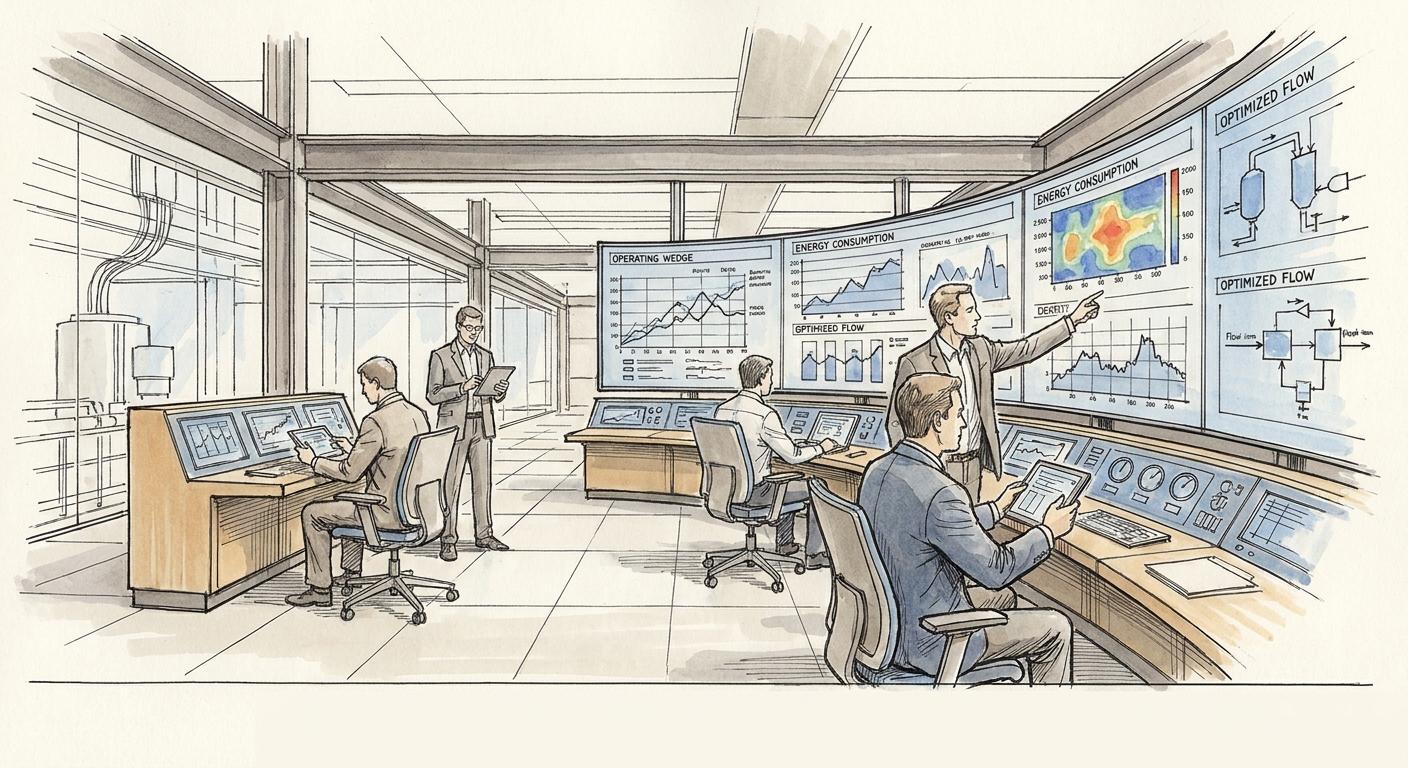
By synthesizing work orders, maintenance logs, and procurement records, we create a unified baseline of operational health. This allows the PE firm to see the estimate-vs-actual gap in real time. Instead of relying on management’s "gut feeling" about plant capacity, the deal team gains a data-backed view of the operating wedge - the gap between current performance and the theoretical maximum output of the facility.
Phase 2: Running High-Velocity 'What-If' Simulations
Once the baseline is established, the focus shifts to stress-testing the investment thesis. AI scenario planning for manufacturing allows for high-velocity simulations that would take a human analyst weeks to perform. These simulations provide a clear picture of exit readiness by identifying which levers actually move the needle on EBITDA.
Key scenarios include:
- Raw Material Volatility: Modeling the impact of a 10% surge in specialized resin or steel costs and determining if the current pricing strategy can absorb the shock.
- Labor and Shift Optimization: Simulating the EBITDA impact of moving from two shifts to three, or the ROI of automating a specific high-frequency manual task.
- OTIF Sensitivity: Predicting the churn risk of major accounts based on historical delivery delays and calculating the cost of expedited freight versus the cost of holding safety stock.
Phase 3: Validating Margin Expansion via the AI Starter Package
The transition from due diligence to the first 100 days is where most value creation plans stall. Identifying a 200-basis-point margin expansion opportunity is useless if the portfolio company cannot execute. We solve this through a focused AI Starter Package, which takes the highest-impact scenario identified during diligence and moves it into production.
For example, if the model identifies margin leakage in job costing, the initial project focuses on deploying an AI tool that automates precise cost estimation. This provides a quick win for the Portfolio CEO and proves the ROI of the broader repeatable AI playbook. By the time the deal is closed, the infrastructure for the first use case is already in flight, significantly reducing the time-to-value.
Moving from Signal to Action: The 8-Week Implementation Roadmap
Accelerating manufacturing acquisitions with AI requires more than just software; it requires a specialized execution team. Most mid-market manufacturers lack the internal talent to bridge the gap between data science and the shop floor. Hiring a Head of AI is often a 6-month process that ends in a cultural mismatch.
iForAI provides 35+ specialists for the price of a single hire, delivering a live use case in production within 8 to 12 weeks. Our methodology focuses on upskilling the existing workforce to ensure that once a tool is deployed, it is actually adopted by plant managers and coordinators. This ensures that the value creation plan isn't just a slide deck for the LPs, but a functional part of the daily operation that drives a higher exit multiple.
FAQ
How long does it take to stand up an AI scenario model for a target acquisition? With iForAI's methodology, a baseline model can be established in 4-6 weeks during the due diligence window. This provides actionable insights into margin expansion and operational risk before the final deal signing.
Does this require the target company to have 'clean' data? No; modern AI tools are specifically designed to clean, map, and harmonize unstructured manufacturing data. Our execution team specializes in bridging the ERP-MES gap even when legacy systems are in place.
What is the primary benefit of scenario analysis for mid-market manufacturing? It allows PE firms to quantify the operating leverage available in the asset. By simulating different production and market conditions, firms can set more accurate EBITDA targets and build a realistic post-acquisition value creation roadmap.
How does AI scenario planning impact exit readiness? By embedding AI into core operations early, you build a data-driven culture that makes the company more attractive to future buyers. A business with a repeatable AI playbook and transparent operational data consistently commands a higher exit multiple.
AI scenario planning for manufacturing turns due diligence from a defensive exercise into a strategic offensive, allowing PE firms to identify and capture value faster than the competition.
Learn about the AI Starter Package at ifor.ai/solutions/private-equity

Ira Komarova
COO at iForAI