

.svg)

The infrastructure that lets people and AI answer the same question the same way, every time.
The first piece in a series on building a company brain — what it is, why it matters for AI adoption, and how the build runs at a high level. About five minutes to read.
01 What is a company brain?
At iForAI we work on one mission: turning AI into business performance. This article opens a series about the system that makes it possible — the company brain. This first piece covers what a brain is, why you need one, and how the work runs at a high level; the following articles take each step in depth, starting with mapping.
Ask your company one simple question: who is this customer, and what did we agree with them?
In most companies that answer arrives from three places at once. A CRM record that's partly filled in. A folder of agreements where the signed one isn't marked. And a person who genuinely knows — and is in a meeting.
A company brain is what ends that. It's the system where every domain of company knowledge — accounts, finance, product, HR — has one source of truth, one owner, and one way to reach it. Everything else references that truth; nothing copies it. Not a new tool and not a database: a set of decisions about where answers live, wired into the systems you already have.
We're building this ourselves
This series follows our own company brain build in real time — the method, not a finished product. We're sharing it as we go.
02 Why you need it
Because the question above gets asked hundreds of times a month — by your team, by new joiners, and now by AI.
A person handles the ambiguity: they know the 2024 version is stale, they know who really owns pricing, they ask someone. An AI can't. It reads both versions of the document, weights them equally, and picks one — sometimes the wrong one, sometimes a different one tomorrow. Every AI initiative you're planning — assistants, agents, automation — runs on your company being able to answer a question once, the same way, twice.
The brain is not an AI project. It's the precondition for every AI project.
03 Productivity and ROI
The return comes from three places, in order of arrival.
Time people stop losing. Every repeated question, every hunt for the current version, every "let's wait until she's back from vacation" — that's a permanent tax on every process. The brain removes it at the source.
Speed of new capacity. A new joiner in a mapped company ramps by reading, not by interrupting. The same is true of a new AI agent — which is the point.
Compounding leverage. Each domain you settle makes the next one cheaper, and every connection you declare makes the existing ones more useful. The wiring, not the model, is the part a competitor can't copy.
In our own build, teams working from a settled domain move through repeatable work roughly 5x faster than before — mostly from cutting out the first two costs above. The measurement approach is below.
04 How it's implemented — the high-level process
Five steps, and the most important rule is that they run per domain, not per company.
01 Map - write down where the answer comes from today, for every domain, and name the gaps honestly.
02 Clean - name an owner, then resolve the conflicts a map found, retire what's stale, and leave one obviously current answer.
03 Connect - wire the domain to AI through a connector — tool-agnostic by design, and scoped to the wiring, not the upkeep.
04 Automate - build on the connected domain — skills, agents, anything repeatable that AI can now run.
05 Govern - run a recurring automated check that compares the source of truth against reality and flags drift, so the domain stays both clean and relevant.
A domain moves when it's ready — nobody waits for the slowest team. Finance can be three steps ahead of product.
05 How you measure it
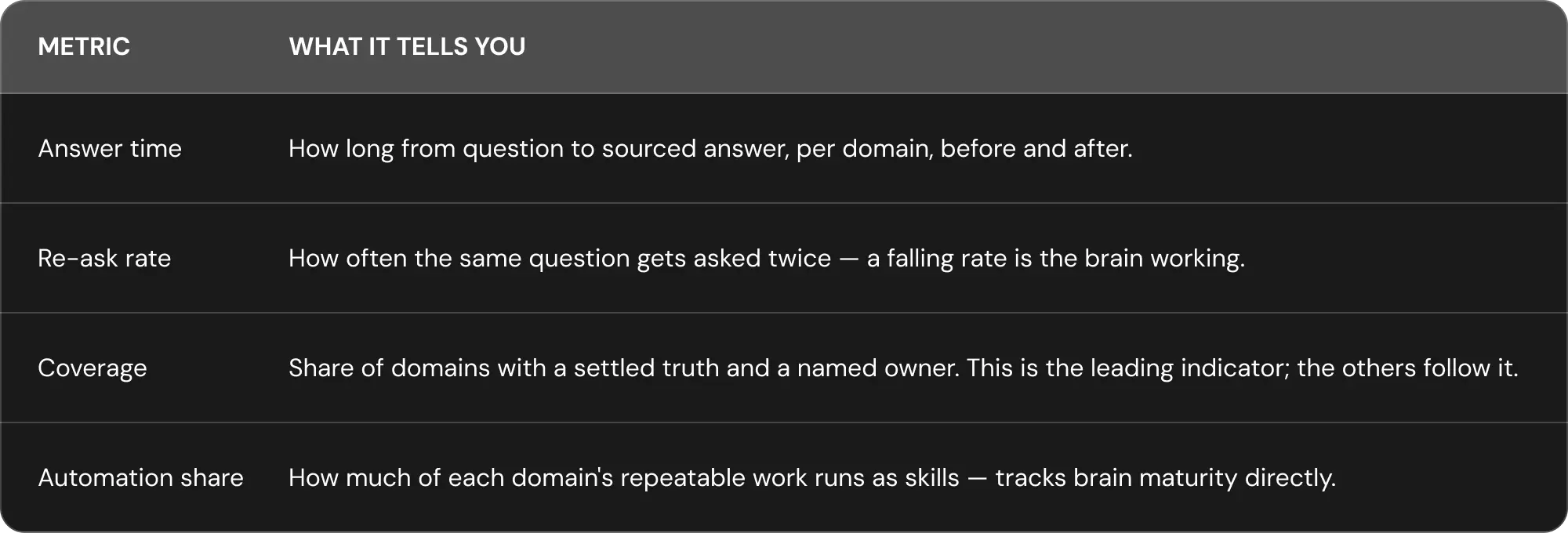
Measure the brain like an operations system, not a campaign. Pick the baseline before you start — the companies that skip it are the ones quoting ROI they can't defend a year later.
06 AI-first: extending your team, not replacing it
Here is where the mission comes back in. The goal of the brain is not tidy data — it's to let AI extend your current team's force.
Once a domain has a settled truth, an AI agent working in that domain stops being a demo and becomes a colleague: it answers from the same source your best person would, files what it produces back into the truth, and says so when a source is unreachable instead of guessing. That's the multiplier — not one assistant doing everything, but every team running with AI capacity attached to work that used to queue on people.
That's what AI-first means in practice: the same team, with more force behind it. And it starts with knowing where your answers live.
Part 2 covers the first step in detail — mapping your data, the MVP approach to scope, and the three failure patterns a map reveals.

Asaf Yosifov
Founder & CEO Asaf Yosifov