

.svg)

Most portfolio CEOs are currently caught between a mandate from their Operating Partners to "do something with AI" and a healthy skepticism of high-priced consultants promising long-term transformation. Without a rigorous AI integration checklist, many firms fall into the trap of AI tourism - funding pilots that never reach production or purchasing expensive "shelfware" that fails to drive margin expansion. This guide provides a 10-point framework to evaluate which initiatives will actually deliver value creation and which will merely add technical debt. We will cover how to assess data viability, measure EBITDA impact within 90 days, and ensure your team is equipped for portfolio company AI adoption.
AI Integration Readiness is an assessment framework used by PE portfolio leadership to determine if a specific AI application has the necessary data foundation, executive alignment, and ROI potential to justify investment within a 12-24 month value creation cycle. It serves as a filter to separate high-impact operational tools from speculative R&D projects.
Beyond the Hype: Why CEOs Must Gatekeep AI Initiatives
For a PE-backed company, AI is not a tech upgrade; it is an operating wedge. Every dollar spent on AI must be justified by a corresponding improvement in operating leverage or a reduction in margin leakage. CEOs must act as gatekeepers because the market is currently flooded with generic tools that promise efficiency but lack the specific context of your business.
The goal is to avoid "pilot purgatory," where projects consume management's bandwidth for six months without ever hitting the P&L. For the Operating Partner, the priority is exit readiness. If an AI initiative doesn't contribute to a repeatable, scalable process that a future buyer will value, it is likely a distraction. You need a repeatable AI playbook that moves from concept to production in weeks, not years.
The 10-Point AI Readiness Checklist
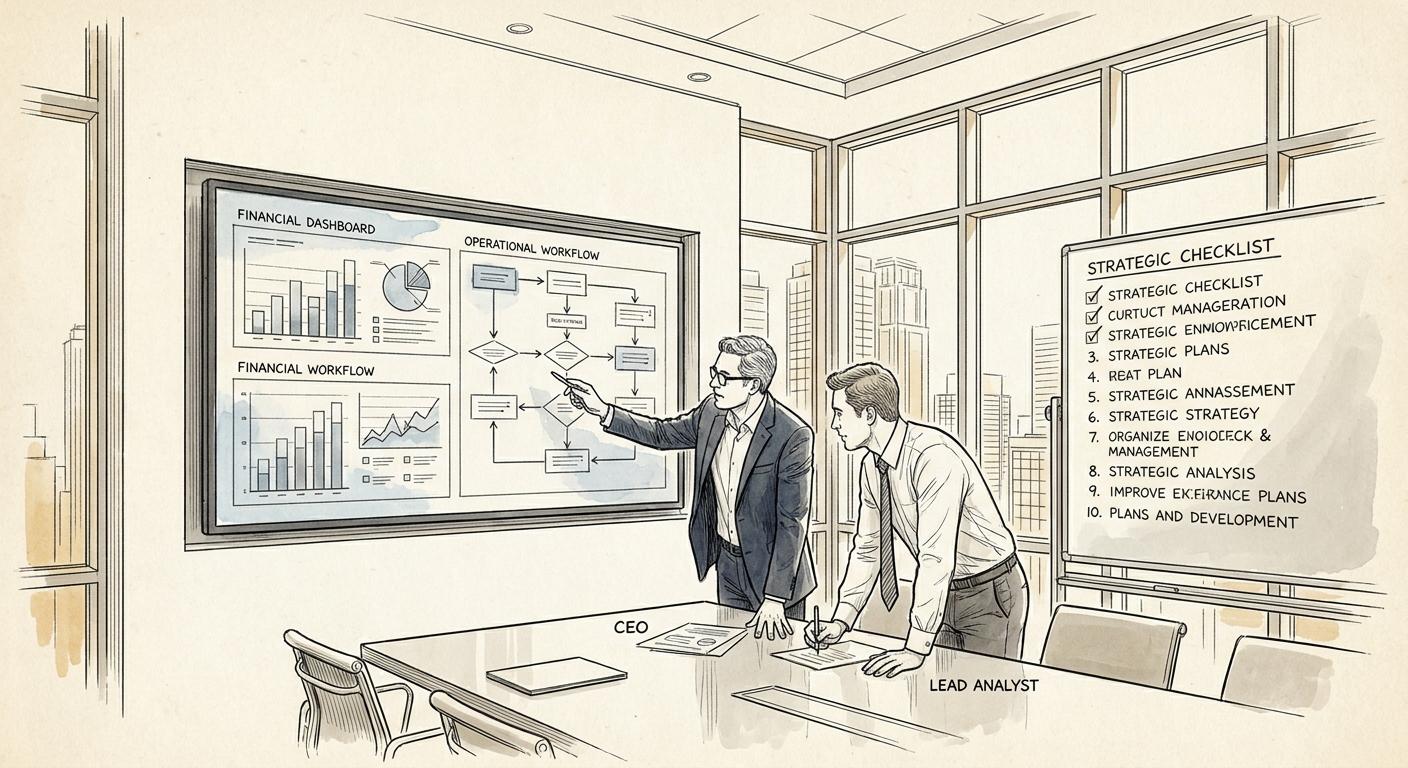
Before approving any AI spend, CEOs should run the initiative through this 10-point diagnostic. This ensures the project aligns with the value creation plan and has a clear path to AI ROI measurement.
- Does this use case directly impact a primary EBITDA lever?
- Is the required data accessible, or is it trapped in disconnected ERP/MES silos?
- Can we show a measurable "quick win" within the first 60-90 days?
- Do we have a specific executive sponsor who owns the outcome?
- Is the technical debt created by this tool manageable for our current IT team?
- Does this solve a "top 3" pain point for our frontline operators?
- Is there a clear plan for upskilling the employees who will use the tool?
- Can the results be audited and reported to LPs with high confidence?
- Is the solution "embedded" into existing workflows rather than being a new login?
- Does this project increase the company’s valuation multiple for the next exit?
Question 1-3: Identifying High-Impact Use Cases vs. Cost Centers
The first three questions focus on financial and operational alignment. Many companies start with AI for HR or legal - areas that are easy to experiment in but rarely move the needle on a post-acquisition AI value creation plan. Instead, look at the core of the business.
In manufacturing, this might mean using AI to close the estimate-vs-actual gap in job costing. In a B2B service business, it could be reducing manual effort in customer service or payment validation. For example, iForAI helped a client reduce validation time from 3 minutes to 20 seconds. These are the types of gains that create operating leverage. If the project doesn't hit a core metric like OTIF (On-Time, In-Full) or customer churn, it may be a cost center in disguise.
Question 4-7: The Infrastructure and Data Reality Check
Questions four through seven address the "delayed execution truth." AI is only as good as the data it consumes. If your data is siloed across legacy systems, the "time-to-value" will likely be too long for a typical PE investment window.
An embedded AI approach doesn't require a total data warehouse overhaul. Instead, it focuses on the specific data streams needed for a single use case. This allows for AI readiness for private equity portfolio companies to be built incrementally. If your data is "messy" but accessible, a specialized execution partner can often clean and structure it in a way that allows for a live production tool in under 12 weeks.
Question 8-10: Cultural Adoption and the Upskilling Mandate
The final three questions are the most common points of failure. Even the most sophisticated AI tool will fail if the staff doesn't use it. Low adoption of tools like Microsoft Copilot is a recurring theme in mid-market companies.
Upskilling is the bridge between purchasing a tool and achieving ROI. Your team must be trained not just on how to use the software, but how to change their daily workflows to take advantage of it. iForAI has trained over 1,500 employees, ensuring that the portfolio-wide AI strategy doesn't stop at the C-suite. Culture change happens when employees see AI reducing their manual workload, such as the 60% reduction in manual service effort achieved by some of our clients.
From Checklist to Execution: The 90-Day Production Sprint
Once you have verified readiness via the checklist, the focus must shift to speed. Long-dated R&D projects are the enemy of EBITDA improvement. The most successful PE firms use a fixed-scope approach to get a single use case live in production within a 90-day window.
The iForAI Starter Package is designed for this exact purpose. It provides a low-risk entry point for the PE firm to test a specific use case, deliver executive training, and build a long-term roadmap. By skipping the lengthy discovery phases typical of traditional consultancies, portfolio companies can see their first measurable results within the first 100 days post-acquisition. This moves the organization from AI maturity on paper to actual value creation in the bank.
Frequently Asked Questions
How soon should a PE-backed company see ROI from AI? Measurable results should emerge within 60-90 days if focusing on a specific, production-ready use case. For example, a targeted reduction in manual data entry or improved job costing accuracy can provide immediate P&L impact.
What is the biggest risk in portfolio AI integration? The biggest risk is "shelfware" - purchasing high-cost licenses like Copilot without a clear upskilling plan, leading to low adoption. Additionally, building complex tools that don't align with the exit strategy can create technical debt that complicates the next sale.
How do you measure AI impact on EBITDA? Impact is measured by tracking specific operational KPIs, such as a reduction in labor hours per unit of output or a decrease in margin leakage due to pricing errors. These improvements are then rolled up to show an increase in total operating margin.
What is the best way to start AI readiness for private equity portfolio companies? Start with a diagnostic that evaluates both technical infrastructure and team skills. Focus on one high-impact use case that can be moved into production quickly to prove the concept to both the board and the employees.
The path to AI-driven value creation requires moving past generic pilots and focusing on specific, margin-improving use cases. By using a structured readiness checklist, CEOs can ensure that every AI dollar spent contributes directly to EBITDA and exit readiness.
Learn about the AI Starter Package at ifor.ai/solutions/private-equity