

.svg)

Most COOs are currently managing the fallout of inconsistent demand, where the delta between sales forecasts and actual production leads to margin erosion or missed delivery dates. Traditional forecasting methods rely on historical averages that cannot account for today's supply chain volatility, causing unnecessary inventory holding costs and frequent OTIF misses. Implementing AI demand forecasting manufacturing solutions allows operations leaders to move beyond spreadsheets and legacy ERP logic to achieve a granular understanding of future requirements. This article examines how machine learning closes the estimate-vs-actual gap and delivers measurable EBITDA improvement within a single quarter.
AI demand forecasting manufacturing is the application of machine learning algorithms to historical sales, operational, and external data to predict future customer demand with higher precision than traditional statistical methods. By identifying non-linear patterns in data, these models help manufacturers optimize production schedules and reduce excess safety stock. The High Cost of 'Close Enough': Why Traditional Forecasting Fails Today In many mid-market manufacturing firms, the demand planning process is still a manual exercise involving exported CSVs and "gut feel" adjustments from sales teams. This reliance on static historical snapshots creates a delayed execution truth, where production is always reacting to what happened last month rather than what is happening now. When the forecast is "close enough," the business hides the inefficiency through bloated safety stock, which ties up working capital and increases warehouse overhead.
The gap between the ERP’s logic and the reality of the shop floor often leads to margin leakage. If the forecast misses by 15%, the resulting scramble - expedited shipping, overtime labor, and emergency raw material surcharges - eats the profit margin on that run. iForAI has observed that firms using traditional methods often see a 20-30% variance in estimate-vs-actual performance, a metric that directly impacts exit readiness for PE-backed companies. From Reactive to Proactive: How AI Models Identify Hidden Demand Patterns Unlike standard regression models, predictive analytics manufacturing tools ingest disparate data streams to identify signals that humans often miss. This includes macro-economic indicators, weather patterns, and even localized lead-time shifts from Tier 2 suppliers. By connecting these variables, AI can predict demand spikes with enough lead time to adjust procurement strategy, ensuring that production starts with the right materials at the right price.
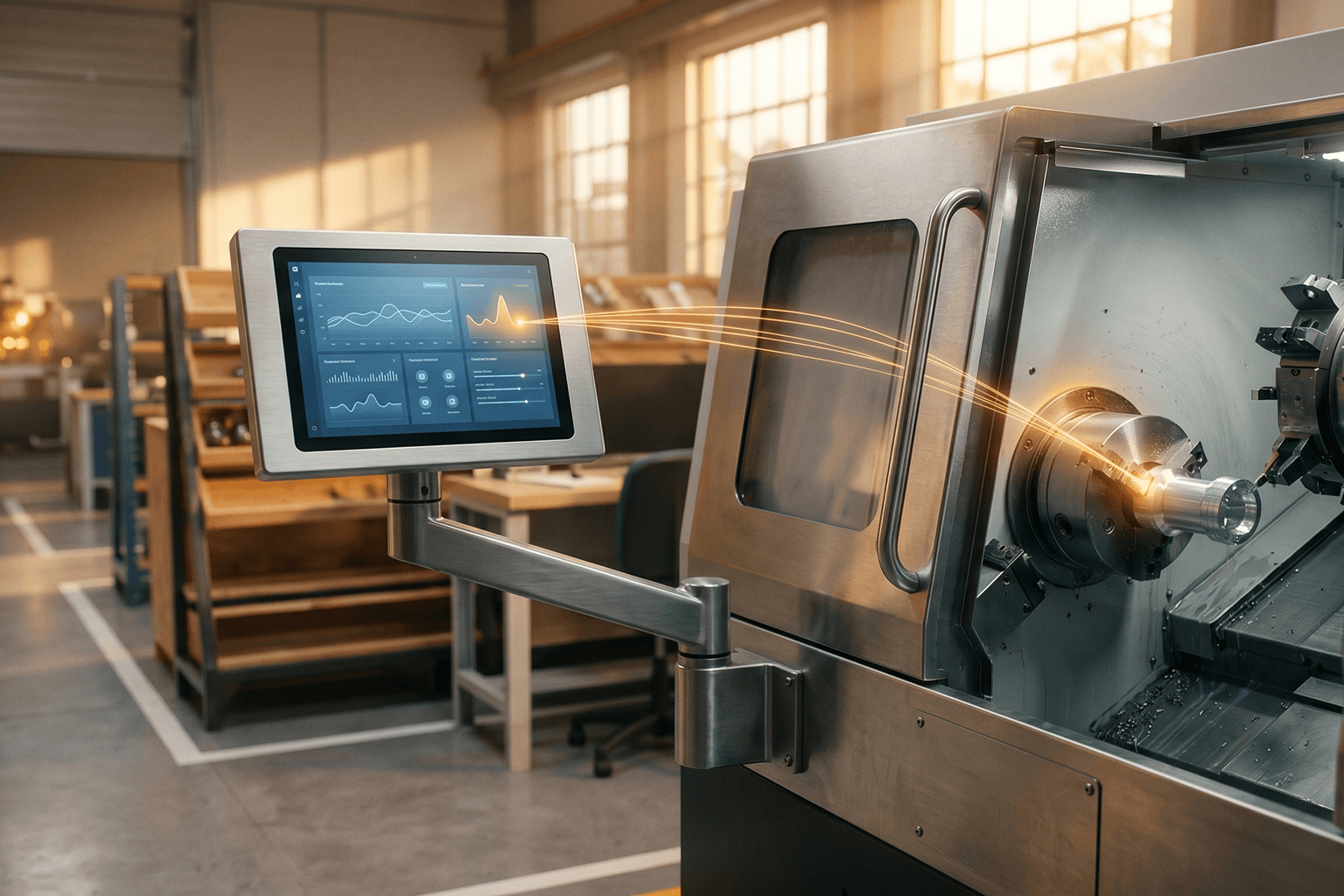
Moving from a reactive to a proactive stance requires closing the ERP-MES gap. When data flows seamlessly from the production floor back into the forecasting engine, the model learns the reality of machine uptime and labor constraints. This results in a "living" forecast that adjusts based on actual output, not just theoretical capacity. At iForAI, we have seen this approach reduce manual customer service effort by 60% as delivery dates become more predictable and accurate. The Bottom Line: Reducing Inventory Holding Costs by 20%+ The most immediate impact of improved forecast accuracy is the liberation of cash flow. A 20% improvement in accuracy does not just mean better planning; it translates to a 15-20% reduction in inventory holding costs as safety stock levels are right-sized. For a manufacturer with $10M in standing inventory, even a conservative 10% reduction provides $1M in liquidity - a significant quick win for any PE Operating Partner looking to improve the operating wedge.
Beyond the warehouse, accuracy improves operating leverage. When the plant knows exactly what needs to be built and when, changeover times are minimized and production runs are optimized for maximum throughput. This stability creates a repeatable value creation playbook that can be showcased during portco exit proceedings to justify a higher exit multiple. Overcoming the Data Gap: Connecting AI to Your Existing ERP and MES One of the primary reasons AI pilots fail is the misconception that a company needs "perfect" data or a total system overhaul to begin. In reality, most manufacturing organizations already possess the necessary data trapped within their ERP and MES systems. The challenge is not the quantity of data, but the AI readiness and the infrastructure to pipe that data into a production-ready model.
Generating first measurable results in 60-90 days is possible by focusing on a specific product line or high-margin category first. This "narrow and deep" strategy avoids the pitfalls of large-scale IT projects that take years to deploy. By leveraging embedded AI that sits on top of existing stacks, COOs can gain visibility without the risk of a "rip and replace" strategy. iForAI’s 35+ specialists provide the technical execution across the entire stack, essentially acting as an outsourced AI department for the price of a single hire. The iForAI Strategy: Implementing Production-Ready Forecasting in 12 Weeks To move from an experimental pilot to a tool that plant managers actually trust, the implementation must include a heavy focus on upskilling. AI should never be a "black box" that dictates orders to the shop floor. Instead, it must be presented as a decision-support tool. Our repeatable AI playbook involves training front-line operators and planners to interpret AI outputs, ensuring high adoption and long-term EBITDA improvement.
Our AI Starter Package for PE is designed to take a single high-impact use case, like demand forecasting, and move it into full production within 12 weeks. This timeline aligns with the first 100 days of an acquisition or a mid-hold value creation push. By combining technical strategy with hands-on execution and team training, we ensure the technology drives actual floor-level results, not just slide-deck screenshots. Frequently Asked Questions How much data do we need to start AI demand forecasting? While more data generally improves model sensitivity, 12 to 24 months of historical ERP and sales data is typically sufficient to build a high-impact initial model. This allows the AI to identify seasonal trends and baseline demand patterns effectively.
Will this replace our existing demand planners? No, AI is designed to augment demand planners by automating the labor-intensive mathematical modeling. This allows your team to shift their focus toward strategic supplier relationships, exception management, and high-level supply chain optimization.
What is the typical time-to-value for an AI forecasting project? With a focused scope, most manufacturing organizations can see their first production-ready results in 60 to 90 days. This timeline includes data ingestion, model training, and integration into existing workflows.
How does AI demand forecasting improve OTIF? By accurately predicting demand, manufacturers can align their raw material procurement and production schedules more tightly. This reduces stockouts and production bottlenecks, leading to more reliable "On-Time, In-Full" delivery performance.
Precision in demand planning is the difference between a high-performing asset and one plagued by margin leakage and inefficient capital use. By shifting to an AI-driven forecasting model, manufacturers can stabilize their operations and significantly improve their valuation.
Book a Manufacturing Diagnostic at ifor.ai/solutions/manufacturing