

.svg)

Unplanned downtime at a 150-employee machining facility doesn't just stall a single cell; it creates margin leakage that ripples through the entire P&L. When a critical asset fails mid-shift, the immediate costs of emergency repairs are often dwarfed by missed OTIF targets and expedited shipping fees. Calculating predictive maintenance ROI allows plant managers and COOs to move from reactive "firefighting" to a data-driven strategy where maintenance is a contributor to operating leverage rather than a sunk cost. This article breaks down the financial framework for measuring AI’s impact on throughput, machine health, and bottom-line EBITDA. The High Cost of Reactive Maintenance in Multi-Site Operations For a multi-site operator, reactive maintenance is a primary driver of delayed execution truth. When one plant in a portfolio underperforms due to equipment failure, the burden shifts to other facilities, often leading to overtime labor and increased logistics costs. Standard industry estimates suggest that unplanned downtime costs industrial manufacturers approximately $50 billion annually.
In a mid-market job shop, the "true cost" of a breakdown includes the lost estimate-vs-actual margin on the specific job, plus the idle labor cost of operators waiting for a fix. Across multiple sites, this lack of visibility prevents the corporate office from accurately forecasting quarterly output. Relying on "run-to-fail" strategies ensures that value creation is suppressed by volatile maintenance cycles and bloated spare parts inventories held "just in case." The ROI Framework: Moving Beyond Simple Cost Savings Predictive Maintenance (PdM) ROI is a financial metric used by manufacturing executives to measure the net profit generated by AI-driven maintenance versus the total cost of deployment, typically focusing on OEE increases and downtime reduction. To build an accurate predictive maintenance business case, leadership must look beyond simple repair bill reductions.
A robust ROI framework includes:
OEE Improvement AI: Increasing Availability and Performance metrics by identifying micro-stops before they escalate into catastrophic failures. Labor Optimization: Shifting maintenance teams from 24/7 on-call emergency status to scheduled, high-value intervention blocks. Extended Asset Lifecycle: Reducing the "wear and tear" caused by operating machinery at sub-optimal tolerances, thereby deferring capital expenditures. Inventory Carry Costs: Using embedded AI to predict exactly which bearings or actuators will fail, allowing for "just-in-time" parts procurement. Quantifying the 'Unquantifiable': Throughput Gains & Revenue Capture The most significant impact of AI in manufacturing for plant managers isn't savings - it's the ability to capture more revenue from the same fixed asset base. If a plant with $20M in annual revenue increases its uptime by 5% through predictive insights, it effectively opens up $1M in additional capacity without adding a single machine or shift.
For Private Equity parents, this represents a significant EBITDA improvement trigger. In a high-margin environment, every hour of recovered uptime flows almost directly to the bottom line, minus the marginal cost of raw materials. This shift moves maintenance from a "cost center" to a "revenue enabler," shortening the time-to-value for digital transformation initiatives. The Operating Wedge: Implementing a Proof of Value in 8 Weeks Large-scale digital overhauls often fail due to complexity and lack of focus. We recommend creating an operating wedge - a targeted application of AI on a single, high-consequence pilot line. This quick win approach validates the predictive maintenance ROI before capital is committed to a full-scale rollout.
An 8-week pilot typically follows this path:
AI Readiness Assessment: Auditing existing sensor data or installing external vibration and thermal sensors on legacy equipment. Baseline Definition: Establishing the current job costing and downtime frequency of the asset. Model Deployment: Implementing narrow AI models to detect anomalies in real-time. Value Attribution: Measuring the delta between predicted failures and actual prevented downtime to prove the financial case. Scaling Success: From One Pilot to Multi-Site Standard The challenge for the COO is maintaining multi-site operational efficiency when plant A uses modern CNCs and plant B relies on 30-year-old hydraulic presses. Industrial AI deployment succeeds at scale when the data layer is standardized, regardless of the machine's age. Using edge computing to normalize data from disparate PLC brands allows for a "single pane of glass" view across the portfolio.
Scaling requires a cultural shift where plant-level teams trust the AI's "red light" indicators. When surgeons at a 200-employee medical device plant in Indiana transitioned from scheduled PMs to predictive alerts, they reduced their scrap rate by 12% because the machine was no longer running in a degraded state. This consistency is what builds the reliable operating wedge needed for a successful 18–36 month investment window. FAQ How do you calculate the ROI of AI in manufacturing? Calculate ROI by taking the sum of (Reduced Downtime Hours x Hourly Production Value) plus (Maintenance Labor Savings) and (Spare Parts Reductions), then dividing by the total cost of the AI implementation. Ensure you include the "opportunity cost" of lost throughput in your production value for an accurate figure.
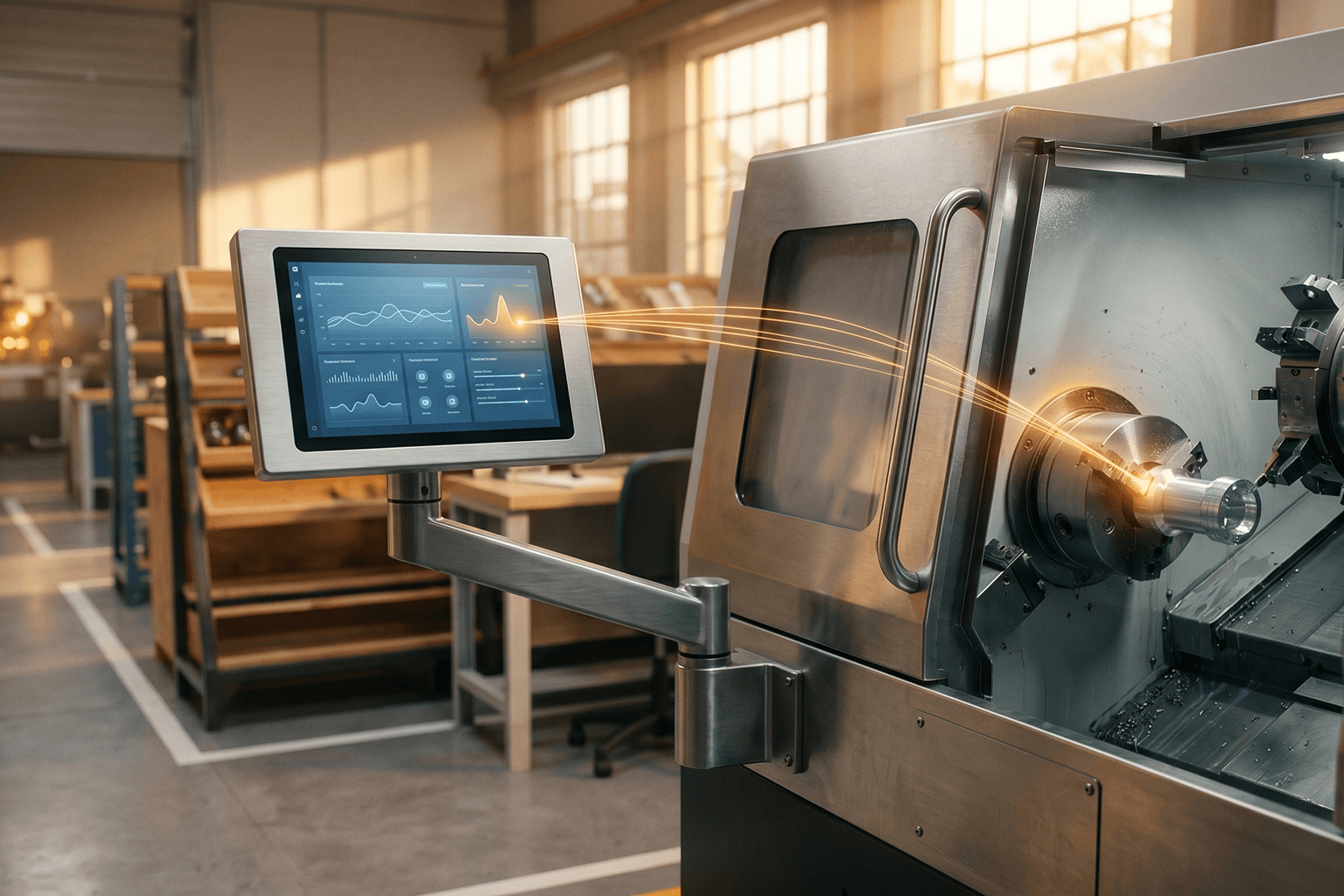
Can predictive maintenance work on legacy equipment? Yes, legacy equipment can be integrated into an AI strategy using external "bolt-on" sensors that measure vibration, acoustics, or heat. These sensors feed data to an edge device, allowing the AI to build a baseline of "healthy" operation without needing to access the machine's internal software.
What is the typical time-to-value for an AI maintenance project? Most manufacturers see a quick win or measurable ROI within 8 to 12 weeks of deploying a pilot program on a critical asset. This timeframe allows the AI to ingest enough operational data to begin identifying anomalies that correlate with mechanical failure.
How does predictive maintenance affect EBITDA? PdM improves EBITDA by reducing operating expenses (labor, parts, emergency shipping) and increasing the "top-line" capacity of the plant. By maximizing the output of existing assets, a company increases its operating margin and valuation multiple.
Quantifying the ROI of predictive maintenance requires moving past vague innovation goals and focusing on specific throughput gains and cost avoidance. By starting with a focused 8-week pilot, manufacturers can prove the financial case and build a scalable foundation for portfolio-wide value creation.
Book a Manufacturing Diagnostic at ifor.ai/solutions/manufacturing.