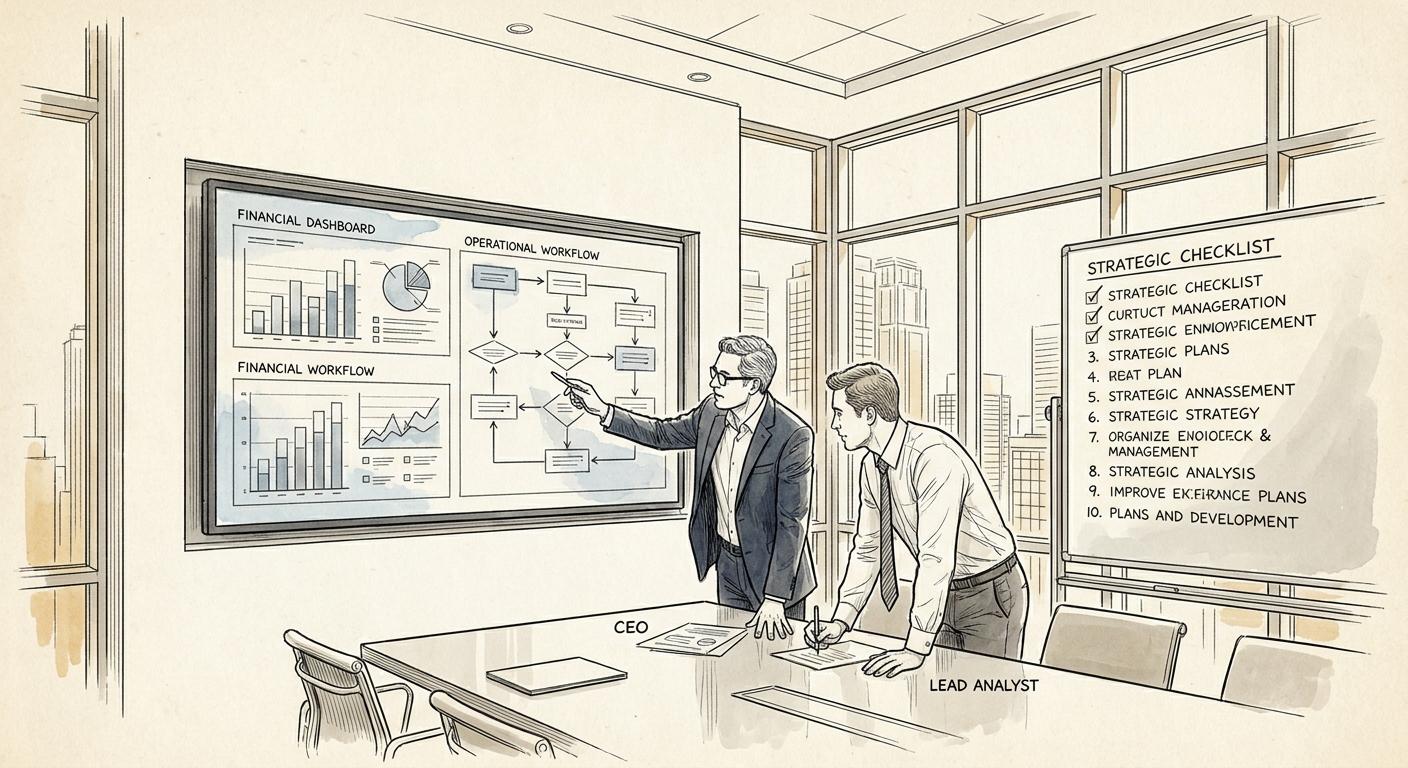
The most impactful advancements in AI are often found not in tech company boardrooms, but in the operational core of various industries. Private Equity (PE) firms, for instance, are making significant investments in AI-integrated service providers within the home health care sector. This trend suggests a strategic shift that leaders across all mid-market enterprises should observe closely.
For founders and innovation leads in service-heavy or SaaS organizations, this isn't merely a healthcare anecdote. It offers a practical framework for moving beyond theoretical AI concepts and achieving measurable return on investment (ROI) in complex operational environments.
Beyond the Hype: Addressing the 'Coordination Tax'
Why home care? This sector presents considerable logistical challenges, characterized by large workforces, dynamic scheduling, and narrow profit margins. Historically, scaling these operations often meant increasing middle management to handle the complexities.
This phenomenon can be termed the Coordination Tax—the escalating cost associated with human oversight required simply to maintain day-to-day operations.
PE firms have recognized that Generative AI is well-suited to mitigate this tax. By deploying Intelligent Agents for tasks such as complex scheduling, real-time compliance monitoring, and precise caregiver-patient matching, they are transforming labor-intensive processes into efficient, scalable systems. This application of AI goes beyond basic automation; it involves automating decision-making processes that previously demanded extensive human coordination.
The Shift from Concepts to Systems
Many organizations face a common hurdle: they have numerous AI ideas but struggle to translate these concepts from presentations into functional systems.
The recent increase in PE-backed AI integration demonstrates that the technology has reached a significant level of maturity. It has evolved beyond simple chatbot functionalities. Modern Intelligent Agents can interpret business logic, adhere to security protocols, and integrate directly with existing cloud and data infrastructures.
For mid-market companies—typically those with 100 to 1,000 employees—similar opportunities exist across various sectors. Whether in FinTech, InsurTech, or SaaS, the potential for significant gains often lies within repetitive, high-friction operational workflows.
How to Leverage This Trend
To transition from stalled pilot projects to tangible results, a practical execution framework can be employed:
Identify Operational Friction: Pinpoint areas where teams spend excessive time managing data or coordinating personnel, rather than focusing on value creation. These are often the areas with the highest Coordination Tax.
Validate Use Cases: Prioritize AI initiatives based on clear business impact and ROI, rather than pursuing novelty for its own sake. An AI Maturity Framework can help align technical investments with strategic objectives.
Bridge Strategy and Execution: A common reason for AI project failure is a disconnect between strategic planning and technical implementation. Successful adoption requires an "operator mindset," integrating AI directly into existing workflows rather than conducting isolated experiments.
The Bottom Line
Forward-thinking investors are not waiting for a distant AI future; they are actively re-engineering the foundational processes of essential services today.
For your organization, the key question is not whether AI is ready for enterprise application, but rather how quickly you can transform operational inefficiencies into a competitive advantage. In an economic landscape where efficiency is paramount, inaction presents the primary risk.