

.svg)

OpenAI's Operator and the Evolution from AI Assistants to AI Agents
Walk into many high-performing engineering hubs today, and you’ll likely see AI coding assistants active on screens. Developers are generating code faster than ever, yet product shipping dates often remain consistent.
At iForAI, we refer to this as the "Turbocharger in Traffic" problem. There is limited utility in having a powerful engine if the workflow is hindered by manual handoffs, legacy processes, and numerous meetings. Boosting individual speed is beneficial, but if the surrounding workflow is congested, the overall business impact may not materialize.
To unlock measurable return on investment (ROI), mid-market and enterprise leaders can consider moving beyond AI Assistants to deploying AI Agents.
The Fundamental Shift: Reactive vs. Objective-Driven
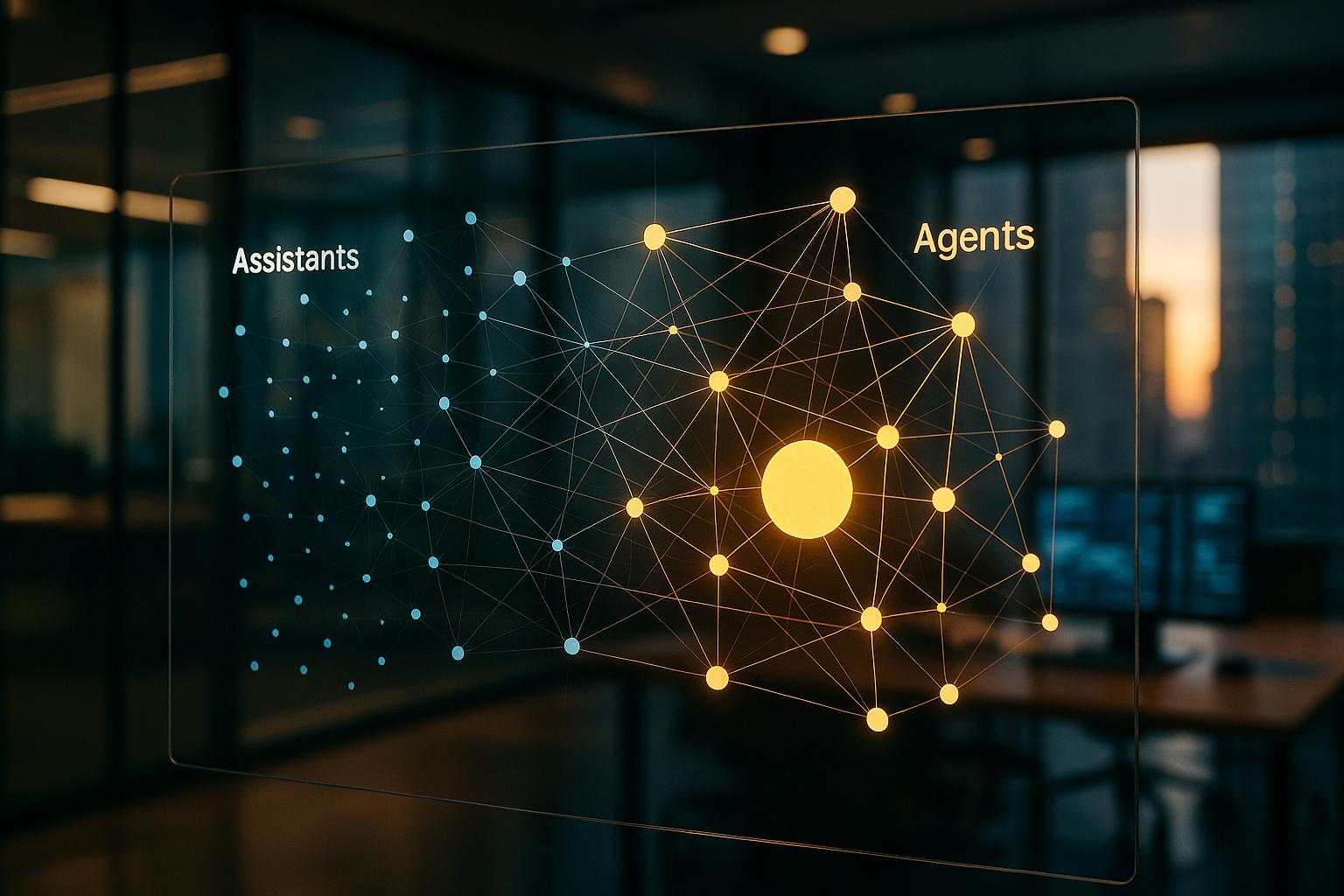
The distinction between an assistant and an agent lies in their operational paradigm.
- AI Assistants are typically reactive. They respond to specific prompts, such as generating a code snippet or summarizing a meeting. They function as task-oriented tools.
- AI Agents are designed to be mission-driven. They aim to understand a broader objective and execute a sequence of steps to achieve it autonomously.
Consider OpenAI’s Operator framework. Instead of merely helping a developer write a line of code, an agent could address a goal like "Prepare this feature for a security audit." In this scenario, the agent might proactively update documentation, verify API dependencies, and identify potential architectural vulnerabilities before a human initiates a Pull Request. One saves minutes; the other can streamline entire development cycles.
Automating the "Connective Tissue" of Business
In our experience helping organizations transition from AI strategy to execution, significant gains often come not from automating isolated tasks, but from improving the connective tissue of the business—the points where work frequently slows down between departments or phases.
We are currently assisting clients in deploying agents to manage high-friction areas within the development lifecycle:
- Living Documentation: Agents can help ensure that technical specifications and READMEs remain synchronized with real-time code changes, addressing "documentation debt" that can affect scaling teams.
- Upstream Validation: Agents can cross-reference Product Requirement Documents (PRDs) against existing system constraints before development begins, potentially preventing costly adjustments later in the sprint.
- Contextual Reviews: AI agents can identify potential conflicts with legacy microservices deep within the system—knowledge often held by a few senior architects.
Turning Prototypes into Enterprise Infrastructure
If an AI strategy focuses solely on individual productivity, it might optimize for activity rather than outcomes. While "Shadow AI"—where individuals use their own tools in silos—can offer some benefits, it may not consistently translate to bottom-line impact.
Achieving AI maturity often involves integrating intelligence directly into core infrastructure, similar to how CI/CD pipelines or cloud monitoring are integrated. This represents a shift from fragmented experiments to a unified, agentic workflow that supports consistent delivery.
Is your team ready to move beyond the prompt? At iForAI, we specialize in bridging the gap between AI potential and business reality. We help build systems that transform AI pilots into measurable, scalable outcomes.