.svg)

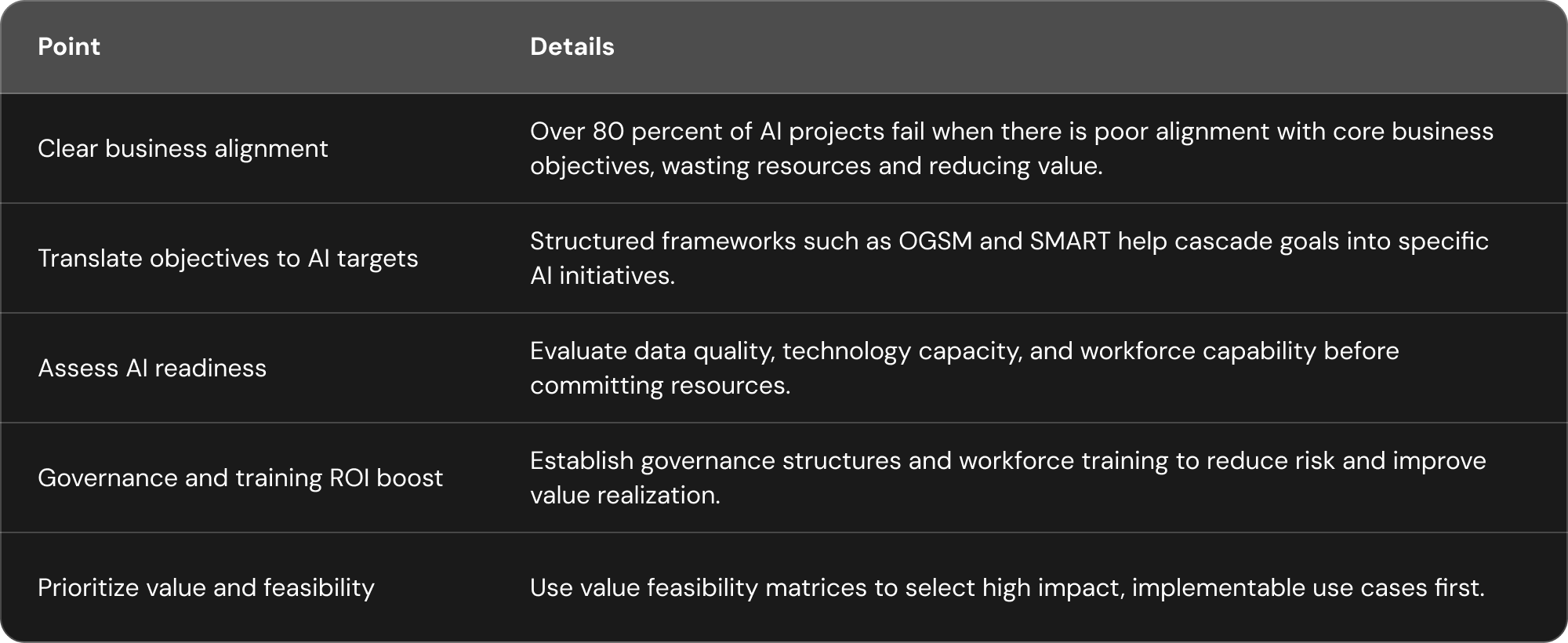
Business executives face a critical challenge: over 80% of AI projects fail primarily due to poor alignment with core business objectives. Without a clear connection between AI capabilities and strategic goals, organizations waste resources on technology that delivers minimal value. This guide provides a structured, actionable framework for aligning AI initiatives with business priorities, from initial preparation through execution and measurement. You’ll learn how to translate business objectives into AI targets, prioritize high-impact use cases, establish effective governance, and verify that your AI investments drive measurable results. By following these proven strategies, you can dramatically improve project success rates and position your organization for sustainable competitive advantage.
Table of Contents
- Key takeaways
- Preparing to align AI with your business goals
- Executing aligned AI initiatives: a step-by-step roadmap
- Avoiding pitfalls and maximizing AI alignment success
- Verifying alignment and measuring AI impact on business goals
- Explore proven AI alignment solutions with iForAI
- Frequently asked questions
Key Takeaways
Preparing to align AI with your business goals
Successful AI alignment starts well before any technology decisions. You need a solid foundation that connects your strategic business objectives with potential AI applications.
Begin by defining clear business objectives and corresponding KPIs. Vague goals like “improve customer experience” won’t guide effective AI investments. Instead, specify measurable outcomes such as “reduce customer service response time by 40% while maintaining 95% satisfaction scores.” This precision enables you to evaluate whether AI solutions actually deliver value.
Next, adopt structured frameworks to translate business aims into AI targets. The OGSM framework and SMART goals provide systematic approaches for breaking down strategic objectives into specific, achievable AI initiatives. OGSM (Objectives, Goals, Strategies, Measures) helps you cascade high-level business priorities into tactical AI projects, while SMART criteria ensure each initiative has clear success metrics.
Conducting an AI readiness assessment is equally critical. This evaluation covers three essential dimensions:
- Data quality and availability: Do you have clean, accessible data to train and operate AI systems?
- Technology infrastructure: Can your current systems support AI workloads and integrate with new solutions?
- Workforce skills and culture: Does your team possess the necessary AI literacy and change readiness?
Assessing organizational readiness across these areas prevents costly missteps. Many organizations rush into AI projects only to discover their data is fragmented or their teams lack basic AI understanding.
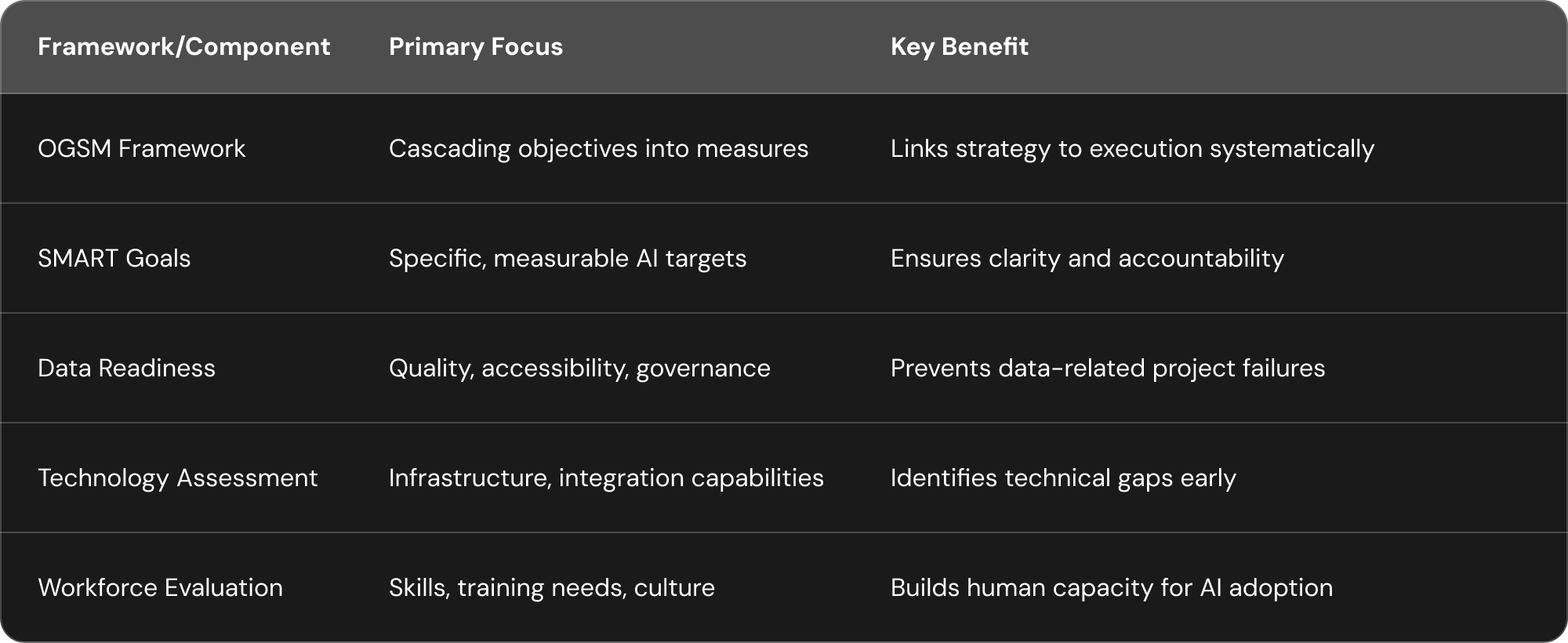
Here’s a comparison of key frameworks and readiness components:
Pro Tip: Involve both business and technical stakeholders from day one. Cross-functional collaboration during the preparation phase prevents the misalignment that derails projects later. Business leaders understand strategic priorities and operational realities, while technical experts know what’s feasible and can identify data or infrastructure constraints early.
For a deeper understanding of where your organization stands, explore our AI maturity guide to benchmark your readiness and identify specific improvement areas.
Executing aligned AI initiatives: a step-by-step roadmap
With preparation complete, you’re ready to execute AI initiatives that directly support business goals. This systematic approach ensures resources flow to high-impact projects.
- Prioritize use cases using value-feasibility matrices. Plot potential AI applications based on business value and technical feasibility. Focus first on high-value, high-feasibility opportunities that can demonstrate quick wins and build organizational confidence.
- Develop a phased AI roadmap that sequences initiatives strategically. Start with pilot projects that address specific pain points and deliver measurable results within 3 to 6 months. Early successes create momentum and secure executive support for larger investments.
- Establish governance structures with clear accountability. Define who owns AI strategy, who approves projects, and how decisions get made. Governance isn’t bureaucracy when done right; it’s the framework that keeps AI aligned with business priorities as projects scale.
- Implement human-in-the-loop oversight for critical AI applications. AI systems make mistakes, especially with edge cases and exceptions. Human oversight dramatically improves accuracy and builds trust with stakeholders who interact with AI-driven processes.
- Define clear metrics tied directly to business KPIs. If your objective is cost reduction, track operational expenses before and after AI deployment. If you’re improving customer experience, measure satisfaction scores, resolution times, and retention rates.
Key governance and stakeholder engagement practices include:
- Establish an AI steering committee with representatives from business units, IT, legal, and compliance
- Create transparent approval processes for new AI initiatives based on alignment with strategic objectives
- Implement regular review cycles to assess project progress against business KPIs
- Develop communication protocols to keep stakeholders informed about AI capabilities, limitations, and results
- Build feedback mechanisms so end users can report issues and suggest improvements
The execution phase is where alignment either holds or breaks down. Technology teams sometimes drift toward technically interesting projects that lack business value. Retaining top ML talent requires giving them meaningful work, but that work must serve business objectives, not just showcase cutting-edge techniques.
As AI capabilities evolve rapidly, particularly with large language models, your enterprise AI strategy must balance innovation with alignment. Chasing every new model or technique dilutes focus. Instead, evaluate new technologies through the lens of your strategic objectives and prioritized use cases.

Avoiding pitfalls and maximizing AI alignment success
Understanding common failure patterns helps you steer clear of expensive mistakes that derail AI initiatives.
The biggest pitfall is launching technology-led AI projects without clear business outcomes. Engineers get excited about sophisticated models, but if those models don’t solve real business problems, they create no value. Technology-first approaches are a major cause of the high failure rates plaguing AI projects. Always start with the business problem, then identify appropriate AI solutions.
Data readiness issues sink many projects. You can’t build effective AI systems on incomplete, inconsistent, or inaccessible data. Before automating any process, ensure you have clean data that accurately represents the scenarios your AI will encounter. Poor data quality guarantees poor AI performance, regardless of model sophistication.
Process stability matters more than most executives realize. AI automates existing processes, so if those processes are chaotic or poorly defined, AI amplifies the chaos. Stabilize and document processes before introducing AI. Otherwise, you’re automating dysfunction.
Edge cases and exceptions pose persistent challenges. AI agents excel at routine scenarios but struggle when confronting unusual situations. If your process involves frequent exceptions requiring judgment calls, pure AI automation will disappoint. Plan for how your system will handle these cases.
“High failure rates stem from technology-first approaches, poor data readiness, and supply chain mismatches. Organizations that begin with business objectives and assess readiness thoroughly achieve dramatically better outcomes.”
Implementing human-in-the-loop governance reduces incidents by 4.2x compared to fully automated approaches. This oversight improves both accuracy and ROI by catching errors before they cascade into larger problems. Design AI systems that flag uncertain decisions for human review rather than forcing full automation.
Pro Tip: Monitor AI performance against KPIs continuously and adapt quickly when metrics drift. AI systems degrade over time as data patterns shift. Regular monitoring lets you retrain models, adjust parameters, or redesign workflows before performance problems damage business outcomes.
Other critical practices to avoid pitfalls:
- Conduct post-implementation reviews to capture lessons learned and refine your approach
- Build contingency plans for AI system failures so business operations can continue
- Invest in change management to prepare employees for new AI-driven workflows
- Set realistic expectations with stakeholders about AI capabilities and limitations
For organizations scaling AI across multiple use cases, lean AI approaches that emphasize rapid iteration and tight business alignment can deliver enterprise impact without massive resource investments.
Verifying alignment and measuring AI impact on business goals
Measuring AI’s business impact requires nuanced approaches that go beyond simple ROI calculations.
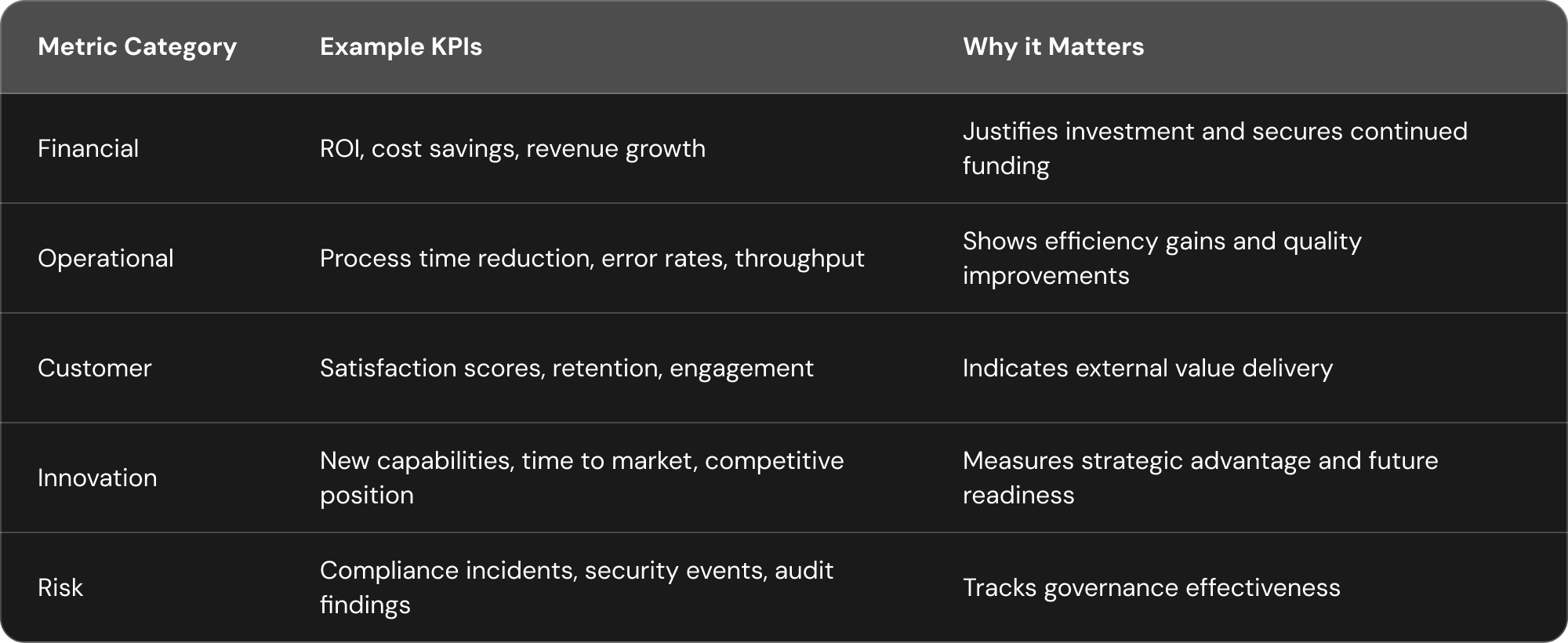
Start with composite KPIs that capture multiple dimensions of value. Financial metrics matter, but operational efficiency, customer impact, and innovation capacity provide a fuller picture. Successful projects achieve a median ROI of 347%, but this financial return stems from improvements across various business functions.

Consider this framework for comprehensive AI impact measurement:
Continuously assess whether your AI initiatives remain aligned with evolving business priorities. Strategic objectives shift, market conditions change, and new opportunities emerge. Your AI roadmap should be a living document that you review quarterly and adjust based on results and changing circumstances.
Key verification practices include:
- Schedule regular alignment reviews with business unit leaders to confirm AI projects still address their priorities
- Collect structured feedback from end users about AI system performance and usability
- Compare actual results against projected benefits from your business case
- Track adoption rates to ensure stakeholders actually use AI tools you’ve deployed
- Document both successes and failures to build organizational learning
Only 5% of organizations achieve substantial value at scale from AI initiatives, making measurement and iteration critical. The gap between pilots and scaled deployment often stems from inadequate measurement systems that fail to prove value or identify scaling barriers.
Prioritize scalability and ethical considerations to sustain benefits long term. Solutions that work for 100 transactions may break at 10,000. Ethical AI practices aren’t just about compliance; they build stakeholder trust and prevent reputational damage that can quickly erase financial gains.
Verification isn’t a one-time activity. Build ongoing measurement into your AI operations so you can spot degradation early, capitalize on unexpected benefits, and continuously improve alignment between AI capabilities and business needs.
Explore proven AI alignment solutions with iForAI
Transforming these concepts into reality requires expertise, proven frameworks, and hands-on support tailored to your organization’s unique context.
iForAI specializes in guiding organizations through AI transformation with a business-first approach that ensures every initiative drives measurable value. Our tailored programs address the full alignment lifecycle, from initial strategy development through implementation and scaling.
Explore our case studies to see how organizations achieved remarkable results by aligning AI with strategic objectives. One particularly compelling example shows how an AI hackathon drove a 36% jump in AI familiarity across the organization, building the cultural foundation for successful AI adoption.
Ready to accelerate your AI journey with expert guidance? Visit iForAI to discover how our transformation solutions can help you achieve the alignment and results your organization needs.
Frequently asked questions
How do I start aligning AI with my business goals?
Begin by clearly defining your business objectives and conducting an AI readiness assessment that evaluates data quality, technology infrastructure, and workforce skills. Engage stakeholders from both business and technical teams early to ensure everyone understands strategic priorities and can identify potential alignment gaps before projects launch.
What are common reasons AI projects fail to align with business needs?
Focusing on technology over outcomes is the primary cause of failure, with over 80% of projects failing due to poor alignment. Poor data readiness, ignoring process realities, and insufficient stakeholder engagement also contribute heavily to projects that deliver impressive technical capabilities but minimal business value.
How can I measure the success of AI alignment efforts?
Use nuanced KPIs beyond financial metrics, including operational efficiency indicators, customer impact measures, and innovation capacity assessments. Continuously monitor these indicators and adjust your AI strategy based on results to sustain value delivery as business conditions evolve.
Why is governance important in AI alignment?
Governance ensures human oversight that reduces incidents by 4.2x while keeping AI aligned with business values and strategic objectives. It supports compliance requirements, manages risks, and maintains stakeholder engagement throughout the AI lifecycle, preventing projects from drifting away from intended business outcomes.
Recommended