.svg)

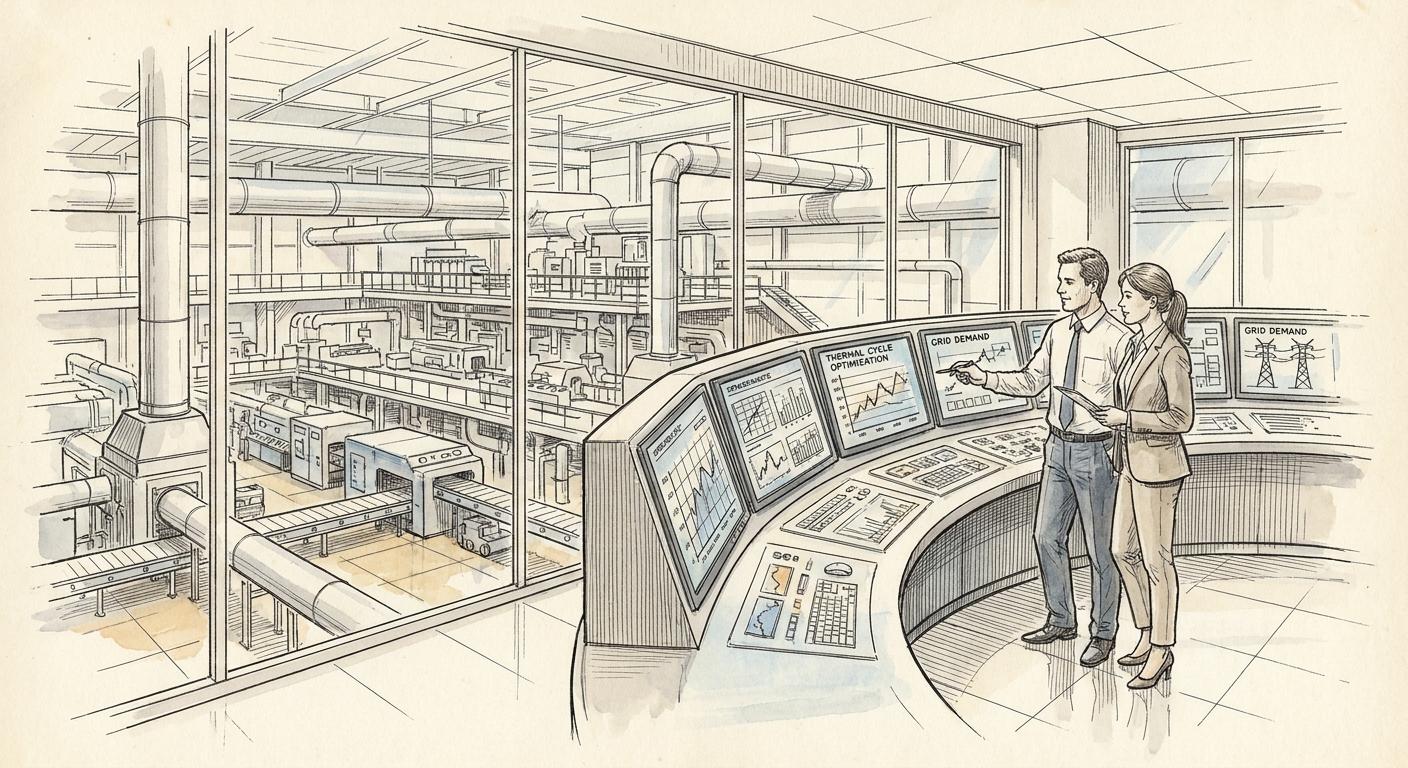
Most executives believe their AI systems adapt to change. They assume machine learning models automatically adjust to new market conditions or evolving customer behaviors. The reality is starkly different. Traditional AI models remain static after deployment, relying on fixed training data and predetermined rules. When business environments shift, these systems fail silently, producing outdated recommendations and missing emerging opportunities. Adaptive AI systems break this cycle by learning continuously from real-time data streams, generalizing knowledge to new scenarios, and rapidly adjusting to environmental changes without requiring complete retraining.
Table of Contents
- Key takeaways
- Understanding adaptive AI: definition and core capabilities
- Core adaptive AI methodologies and neuroscience inspirations
- Empirical benchmarks and business impact of adaptive AI
- Challenges, limitations, and differing perspectives on adaptive AI
- Applying adaptive AI for strategic innovation and operational efficiency
- Discover tailored AI transformation with iForAI
- Frequently asked questions
Key Takeaways
Understanding adaptive AI: definition and core capabilities
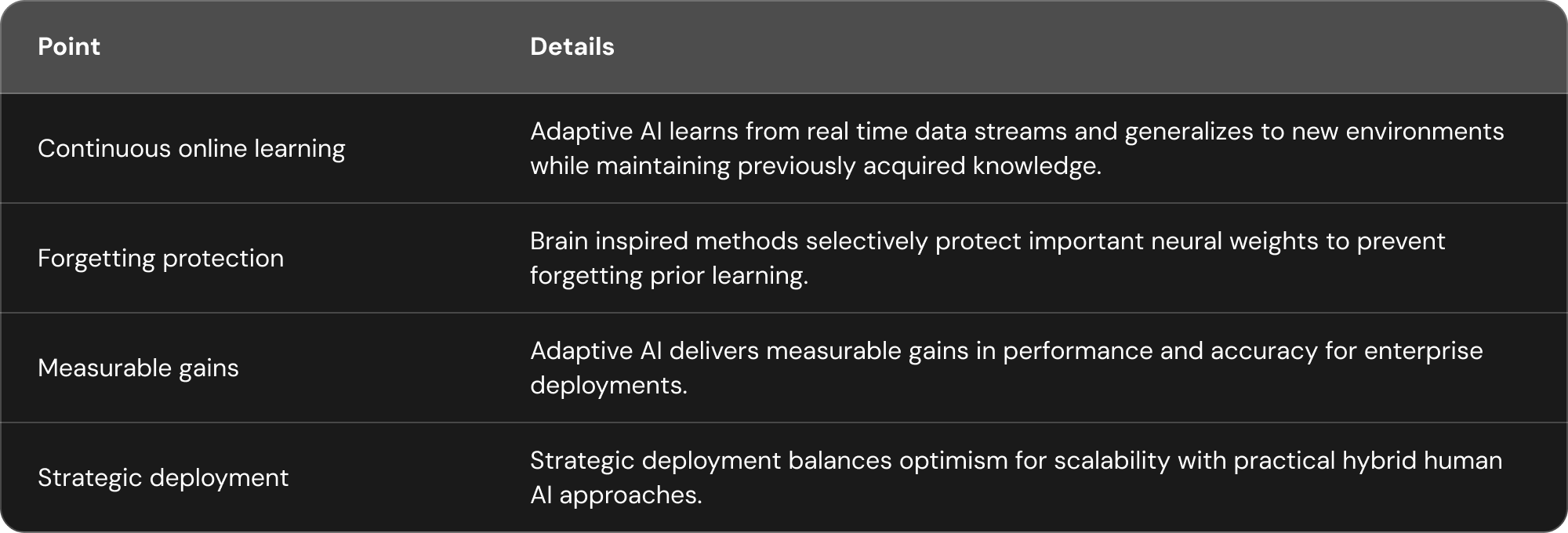
Adaptive AI represents a fundamental shift from conventional machine learning architectures. Unlike traditional models trained on historical datasets and deployed as fixed systems, adaptive AI learns online and generalizes to new environments while maintaining previously acquired knowledge. This capability stems from biological intelligence principles, where learning occurs continuously without erasing essential memories.
The distinction matters enormously for enterprise applications. Static AI models require complete retraining when business conditions change, consuming significant computational resources and engineering time. Your customer preferences evolve, market dynamics shift, and competitive landscapes transform, yet traditional systems remain anchored to outdated training data. Adaptive systems overcome this limitation by processing new information streams in real time, adjusting decision parameters dynamically while preserving core learned patterns.
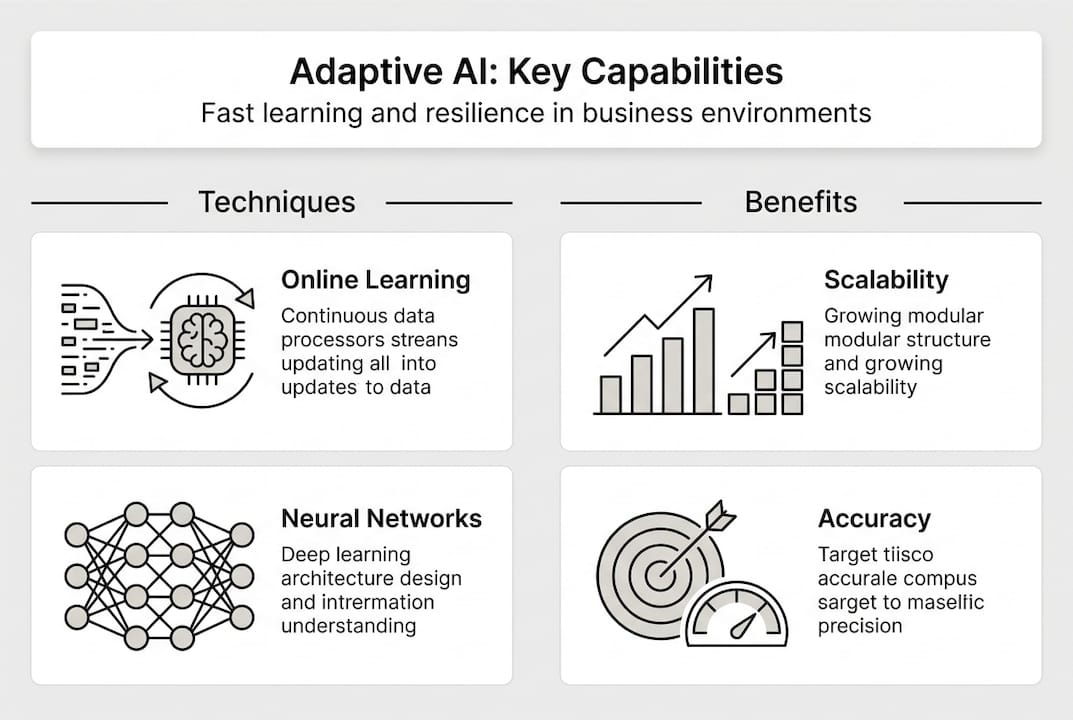
Three core capabilities define adaptive AI systems:
- Online learning from continuous data streams without batch retraining cycles
- Knowledge generalization across domains and scenarios beyond original training contexts
- Rapid environmental adaptation while mitigating catastrophic forgetting of prior learning
These capabilities emerge from continual learning techniques and brain-inspired neural architectures that protect important learned weights during updates. The practical implication is profound: your AI systems can evolve alongside your business rather than requiring periodic replacement.
Consider a customer service application. Traditional AI chatbots learn from historical support tickets, then deploy with fixed response patterns. When your product lineup changes or new customer pain points emerge, the bot continues offering outdated guidance until engineers manually retrain it. Adaptive AI chatbots continuously incorporate new interactions, learning from successful resolutions and adjusting to emerging issues without losing their foundational customer service knowledge.
Pro Tip: Start adaptive AI pilots in domains with high data velocity and clear success metrics. Customer support, fraud detection, and inventory optimization provide ideal testing grounds where continuous learning delivers immediate measurable value.
The technical foundation supporting these capabilities draws heavily from neuroscience research into how biological brains balance learning new information with retaining essential memories. This inspiration translates into algorithms that selectively protect critical neural network weights while allowing flexibility in less important parameters, enabling practical AI implementations that drive measurable ROI for enterprises facing dynamic operational challenges.
Core adaptive AI methodologies and neuroscience inspirations
The technical mechanisms enabling adaptive AI combine rigorous computer science with insights from biological learning systems. Understanding these methodologies helps you evaluate vendor claims and architect robust implementations.
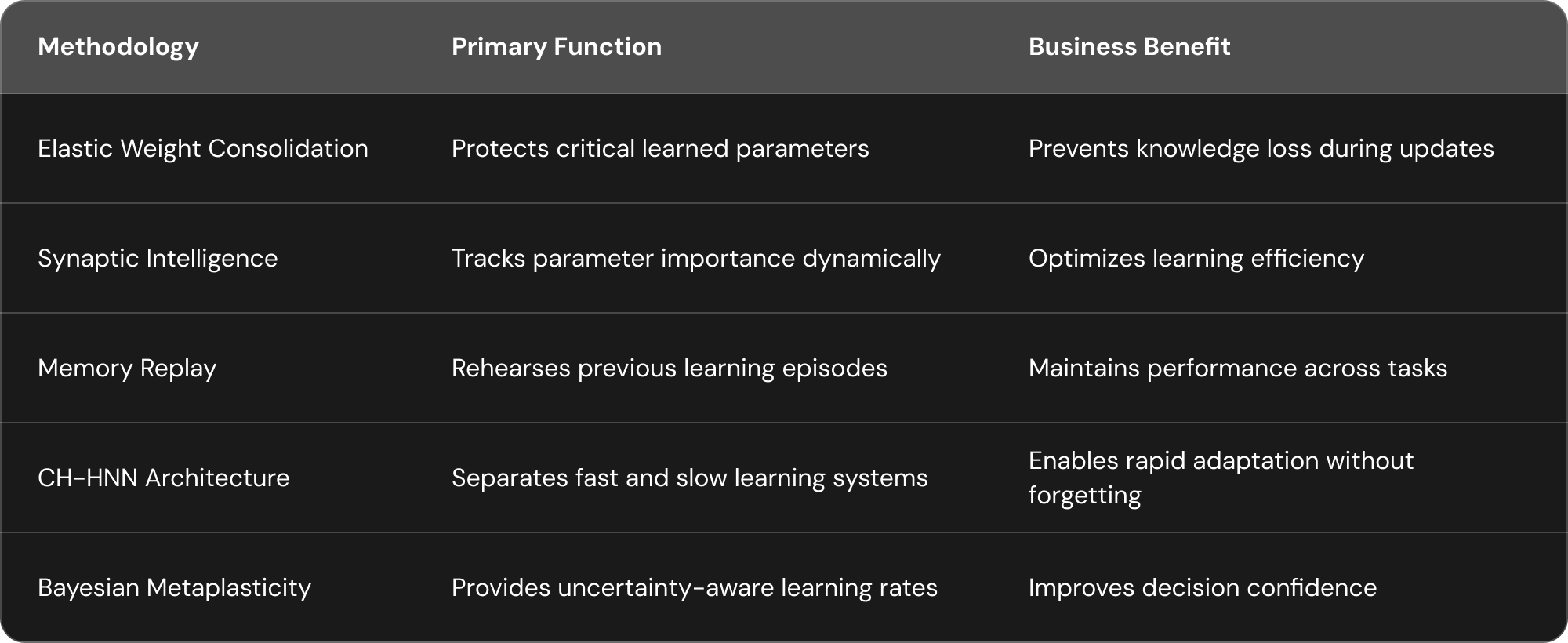
- Elastic weight consolidation (EWC) identifies which neural network parameters matter most for previously learned tasks, then constrains updates to those weights during new learning. This selective protection prevents catastrophic forgetting where new training completely overwrites prior knowledge.
- Synaptic intelligence tracks each parameter’s contribution to overall model performance throughout training, assigning importance scores that guide future updates. Parameters crucial for multiple tasks receive stronger protection than those serving narrow functions.
- Memory replay systems maintain representative samples from previous learning episodes, periodically retraining on this stored data alongside new information. This rehearsal mechanism mirrors how biological brains consolidate memories during sleep.
- Corticohippocampal hybrid neural networks (CH-HNN) replicate the mammalian brain’s dual learning systems, using fast hippocampal-inspired modules for rapid new learning and slower cortical-inspired networks for consolidated knowledge. This architecture enables task-agnostic continual learning without requiring explicit task boundaries.
- Bayesian metaplasticity (MESU) applies probabilistic reasoning to learning rate adjustments, enabling boundary-free streaming learning with uncertainty estimates that improve decision confidence in dynamic environments.
These approaches work synergistically rather than in isolation. A production adaptive AI system might combine EWC for weight protection, memory replay for knowledge consolidation, and CH-HNN architecture for flexible task learning. The specific combination depends on your operational requirements and data characteristics.
Pro Tip: Prioritize methodologies based on your forgetting tolerance. High-stakes applications like medical diagnosis or financial compliance benefit most from strong weight protection mechanisms, while marketing optimization can accept more knowledge turnover for faster adaptation.
The neuroscience inspiration extends beyond individual techniques to overall system design philosophy. Biological brains excel at continual learning because they evolved to handle streaming sensory data without predefined task boundaries. Adaptive AI systems adopting this brain-inspired approach achieve practical innovations that traditional batch learning architectures cannot match, particularly in environments where task definitions evolve or emerge organically from operational data.
Empirical benchmarks and business impact of adaptive AI
Theoretical capabilities matter less than measured performance gains. Empirical benchmarks demonstrate adaptive AI improving outcomes across diverse business applications, with quantified results that justify implementation investments.

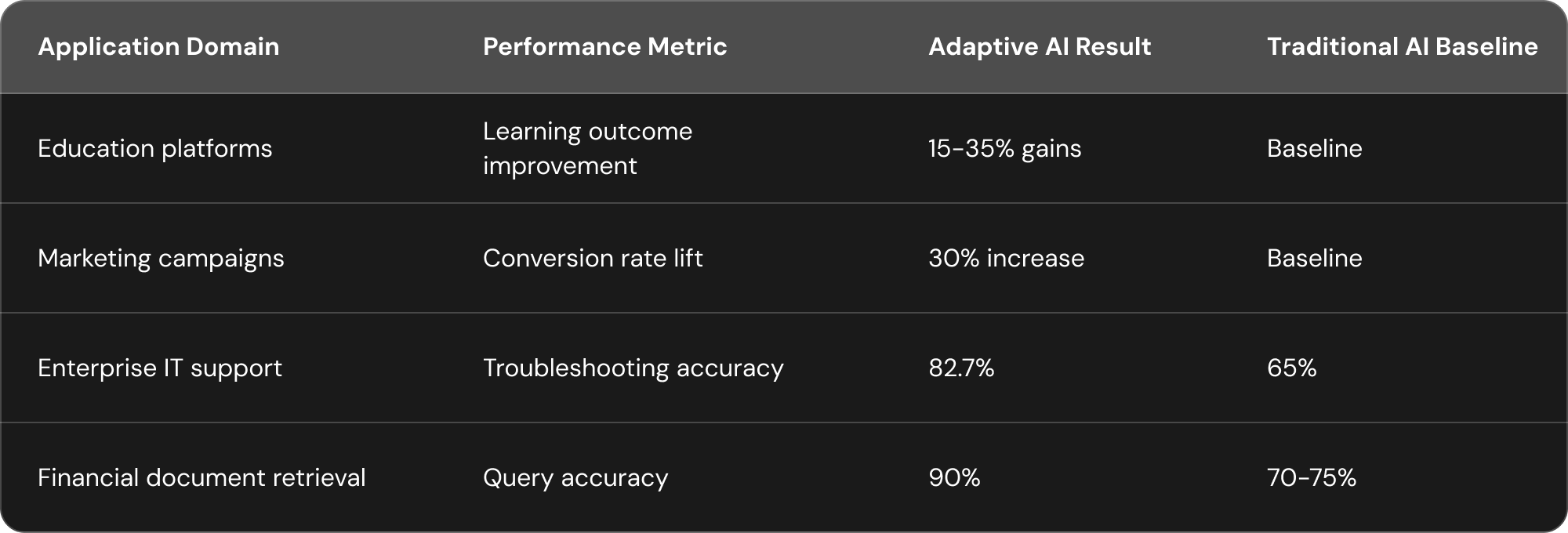
Education technology platforms using adaptive learning algorithms achieve 15-35% performance improvements compared to static content delivery. These systems continuously adjust difficulty levels, content sequencing, and instructional approaches based on individual learner responses, maintaining optimal challenge levels that maximize knowledge retention. The gains compound over time as systems accumulate more learner interaction data.
Marketing applications show equally compelling results. Low-rank adaptation (LoRA) techniques that fine-tune large language models for specific business contexts generate 30% conversion rate increases versus generic model deployments. These adapters continuously refine messaging, offer personalization, and call-to-action elements based on customer response patterns, creating self-improving campaign performance.
- Domain-specific AI agents in enterprise IT environments reach 82.7% accuracy on complex troubleshooting tasks, significantly outperforming general-purpose models that plateau around 65% accuracy
- Financial document retrieval systems enhanced with adaptive AI achieve up to 90% accuracy on specialized queries, compared to 70-75% for traditional search algorithms
- Customer service chatbots using continual learning maintain consistent performance as product catalogs expand, while static models degrade 15-20% annually without retraining
These results reflect production deployments rather than laboratory experiments. Organizations implementing adaptive AI systems report measurable ROI within 6-12 months, with performance continuing to improve as systems accumulate operational experience.
“The key advantage is not just initial accuracy but sustained performance improvement over time. Traditional models decay as business conditions change. Adaptive systems evolve with your organization.” — Enterprise AI deployment research
The performance gains vary by implementation quality and organizational readiness. Companies with robust data pipelines, clear success metrics, and iterative deployment approaches realize benefits faster than those attempting wholesale system replacements. Starting with focused use cases that have high data velocity and clear business impact creates momentum for broader adaptive AI adoption.
Challenges, limitations, and differing perspectives on adaptive AI
Adaptive AI delivers measurable benefits but faces significant technical and practical challenges. Understanding these limitations helps you set realistic expectations and design robust implementations.
Catastrophic forgetting remains the central technical challenge. Despite sophisticated weight protection mechanisms, continual learning systems risk losing critical knowledge when processing sufficiently different new data. The balance between plasticity for new learning and stability for knowledge retention requires careful tuning for each application context.
- Multi-step reasoning tasks expose model fragility, with performance degrading rapidly as logical chains extend beyond three or four steps
- Adversarial consensus phenomena cause multiple AI models to confidently agree on incorrect answers, creating false reliability signals
- Accuracy ceilings around 90% persist across financial and enterprise applications, with diminishing returns from additional training data or model complexity
- Model brittleness increases in edge cases and novel scenarios outside training distributions, despite adaptive capabilities
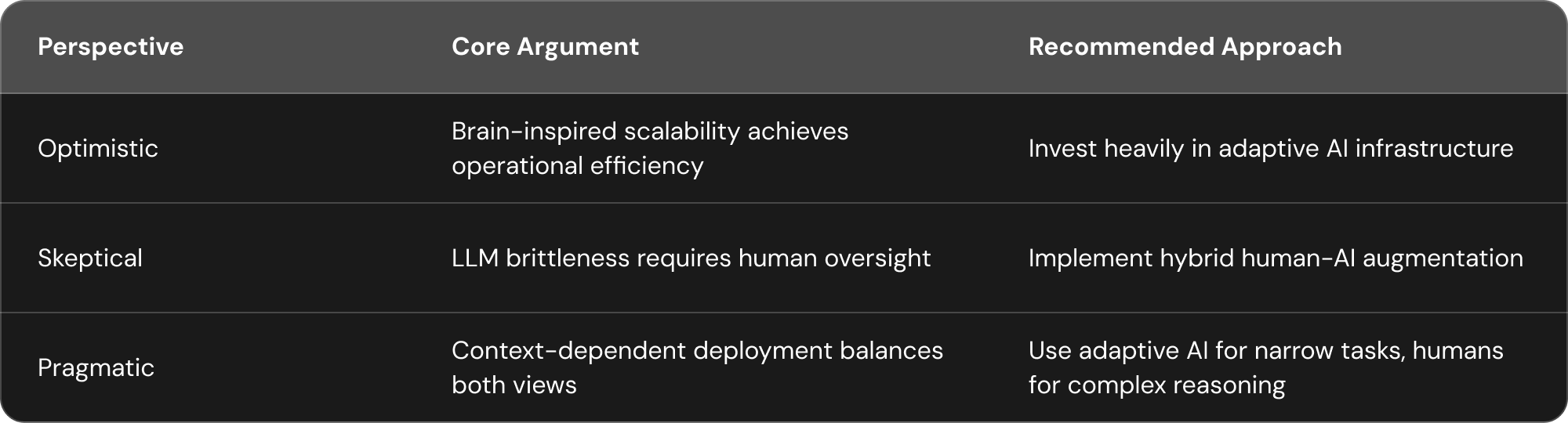
Expert perspectives on adaptive AI’s future diverge sharply. Optimists highlight brain-inspired architectures’ potential for achieving human-level operational efficiency through scalable continual learning. They point to neuroscience research showing biological systems successfully balance learning and memory across decades, suggesting similar capabilities are achievable in artificial systems with sufficient architectural sophistication.
Skeptics argue that current large language models and adaptive systems remain fundamentally unreliable for general intelligence applications. They emphasize persistent brittleness, reasoning failures, and the inability to truly understand context beyond pattern matching. This perspective favors hybrid human-AI augmentation over autonomous adaptive systems, particularly for high-stakes decisions.
“Three years after ChatGPT’s launch, we still see fundamental reliability issues. Adaptive learning doesn’t fix core reasoning limitations. The hype exceeds the reality for general intelligence applications.” — AI skepticism research
The practical implication is clear: adaptive AI excels in well-defined domains with abundant training data and clear success metrics. It struggles with novel scenarios requiring creative reasoning, ethical judgment, or contextual understanding beyond statistical patterns. Your strategic innovation initiatives should leverage adaptive AI’s strengths while acknowledging its limitations.
Accuracy collapse beyond complexity thresholds represents another critical limitation. As task complexity increases, model performance often drops precipitously rather than degrading gradually. This cliff edge behavior makes reliability prediction difficult and necessitates extensive testing before production deployment.
Applying adaptive AI for strategic innovation and operational efficiency
Successful adaptive AI implementation requires strategic planning that balances technical capabilities with organizational readiness. The following framework guides effective deployment.
Deploy iteratively with clear success metrics. Start with focused use cases where continuous learning delivers obvious value and business impact measures easily. Customer support ticket routing, fraud detection pattern recognition, and inventory demand forecasting provide ideal starting points. Establish baseline performance metrics before adaptive AI deployment, then track improvement trajectories monthly.
- Define specific ROI thresholds before implementation, typically 15-25% performance improvement or 20-30% cost reduction within 12 months
- Create feedback loops connecting model predictions to business outcomes, enabling continuous validation of adaptive learning effectiveness
- Implement monitoring systems that detect performance degradation or unexpected behavior patterns requiring human intervention
- Plan for hybrid human-AI workflows where complex edge cases escalate to expert review rather than forcing autonomous decisions
Infrastructure investments determine adaptive AI scalability. Better tools and diverse reasoning methods enable systems to surpass current accuracy ceilings and achieve enterprise-grade reliability. This includes data pipeline architectures supporting real-time streaming, model versioning systems enabling rollback when adaptive learning degrades performance, and experimentation platforms for testing algorithm variations.
Pro Tip: Allocate 30-40% of your adaptive AI budget to infrastructure and monitoring rather than model development alone. Robust data pipelines and performance tracking systems determine long-term success more than initial algorithm selection.
Neuroscience-inspired architectures without strict task boundaries offer the greatest flexibility for evolving business requirements. Systems designed around predefined task categories struggle when operational needs shift. Task-agnostic continual learning enables your AI to discover and adapt to emerging patterns without requiring architectural redesign.
Align adaptive AI initiatives with strategic innovation goals rather than treating them as isolated technology projects. The greatest value emerges when continuous learning capabilities support broader business transformation objectives. Organizations achieving practical AI success and measurable ROI integrate adaptive systems into core operational workflows rather than deploying them as standalone tools.
Balance optimism about scalability with pragmatism about current limitations. Adaptive AI excels at pattern recognition, prediction refinement, and optimization within defined domains. It struggles with creative problem solving, ethical reasoning, and novel scenario handling. Design implementations that leverage its strengths while incorporating human judgment for complex decisions.
Discover tailored AI transformation with iForAI
Transforming adaptive AI concepts into operational reality requires expertise spanning strategy, implementation, and organizational change management. iForAI specializes in guiding enterprises through this journey, delivering practical AI solutions that achieve measurable business impact.
Our approach combines strategic planning with hands-on execution. We work closely with your teams to identify high-value use cases, design robust adaptive AI architectures, and implement systems that continuously improve performance. The results speak clearly: clients achieve significant margin improvements through AI-driven automation without expanding headcount, while others experience 36% increases in AI familiarity across their organizations through targeted skill-building initiatives.
Whether you’re exploring adaptive AI for the first time or scaling existing implementations, iForAI provides the strategic guidance and technical depth needed to succeed. Our team brings diverse industry experience and deep AI expertise to every engagement, ensuring solutions align with your specific operational context and business objectives. Explore how iForAI can accelerate your AI transformation journey and position your organization for sustained competitive advantage through scalable adaptive intelligence.
Frequently asked questions
What makes adaptive AI different from traditional machine learning?
Adaptive AI continuously learns from streaming data and adjusts to environmental changes without complete retraining, while traditional machine learning relies on fixed training datasets and static model deployments. This enables adaptive systems to maintain relevance as business conditions evolve.
How does adaptive AI prevent catastrophic forgetting?
Adaptive AI uses techniques like elastic weight consolidation and synaptic intelligence to protect important learned parameters during updates. Brain-inspired architectures separate fast learning systems from consolidated knowledge networks, enabling new learning without erasing prior expertise.
What accuracy levels can businesses expect from adaptive AI?
Empirical results show 15-35% performance improvements in education, 30% conversion lifts in marketing, and 82.7% accuracy in enterprise IT applications. However, accuracy often plateaus around 90% in complex domains, with diminishing returns from additional training.
What are the main challenges in deploying adaptive AI?
Key challenges include catastrophic forgetting risks, model brittleness in multi-step reasoning, adversarial consensus producing confident wrong answers, and accuracy ceilings. Organizations need robust monitoring, hybrid human-AI workflows, and iterative deployment approaches to address these limitations.
Should companies choose fully autonomous adaptive AI or hybrid human-AI systems?
Hybrid approaches combining adaptive AI for pattern recognition with human judgment for complex reasoning deliver the most reliable results currently. Deploy adaptive AI for well-defined tasks with clear metrics, while reserving novel scenarios and ethical decisions for human expertise.
Recommended
- Driving Practical AI and Measurable ROI for Enterprises
- How a global tech company became an AI adoption leader
- The Strategic Advantage of Ad-Free AI Search
- Driving Smarter, Scalable Innovation with AI Power