
Executives today face a complex challenge when selecting AI strategies that truly fit their organization’s operational reality. The gap between AI’s promise and practical implementation often widens when leaders lack clear evaluation frameworks to balance automation with augmentation. This article delivers a practical, evidence-backed guide to building your 2026 AI innovation roadmap, outlining key criteria, proven options, strategic comparisons, and decision frameworks that drive transformative impact across multiple business levels.
Table of Contents
- Step 1: Define Your AI Innovation Criteria
- Step 2: Explore AI Innovation Options And Their Impact
- Step 3: Compare AI Strategies Side By Side
- Step 4: Decide And Execute Your AI Innovation Roadmap
- What Is An AI Innovation Roadmap And Why Is It Important?
Key takeaways
Step 1: Define your AI innovation criteria
Before exploring AI options, establish clear criteria reflecting your organizational reality and strategic direction. Start by identifying specific business challenges or growth opportunities where AI delivers measurable impact. Your criteria should address four critical dimensions that determine deployment success.
First, define strategic goals with precision. Generic objectives like “improve efficiency” fail to guide meaningful AI investments. Instead, target specific outcomes such as reducing customer service response time by 40% or accelerating product development cycles by three months. These concrete goals create accountability and enable ROI measurement.
Second, evaluate legacy system compatibility rigorously. Many AI initiatives fail because organizations underestimate integration complexity with existing infrastructure. Conduct technical audits to identify potential blockers before committing resources. Edge cases in legacy systems often create unexpected deployment barriers that derail even well-planned initiatives.

Third, design governance frameworks that accelerate rather than obstruct innovation. Traditional IT governance models built for stability often clash with AI’s iterative, experimental nature. Your governance approach should prioritize speed and flexibility while maintaining necessary controls. The EPOCH methodology details four AI strategies balancing automation and augmentation, providing a structured decision framework.
Fourth, determine your preferred balance between augmentation and automation. Augmentation enhances human decision-making and creativity, while automation replaces repetitive tasks entirely. Organizations at different AI maturity stages require different balances. Early-stage adopters often benefit from augmentation strategies that build confidence and skills, while mature organizations may pursue aggressive automation in well-understood processes.
Pro Tip: Map your criteria against the EPOCH framework’s four strategies (Status Quo, Augmentation-led, Human-in-Loop, Displacement-Driven) to quickly identify your optimal starting point and avoid misaligned investments.
Step 2: Explore AI innovation options and their impact
With evaluation criteria established, examine proven AI deployment strategies through real-world case studies that demonstrate tangible business impact. Understanding these options helps you match strategies to your organizational context and risk tolerance.
Automation tools excel at eliminating repetitive, rule-based tasks that consume valuable human time. Organizations implementing automation in data entry, invoice processing, and basic customer inquiries report dramatic throughput increases. However, pure automation strategies face challenges including employee resistance, implementation complexity, and limited applicability to nuanced decision-making tasks.
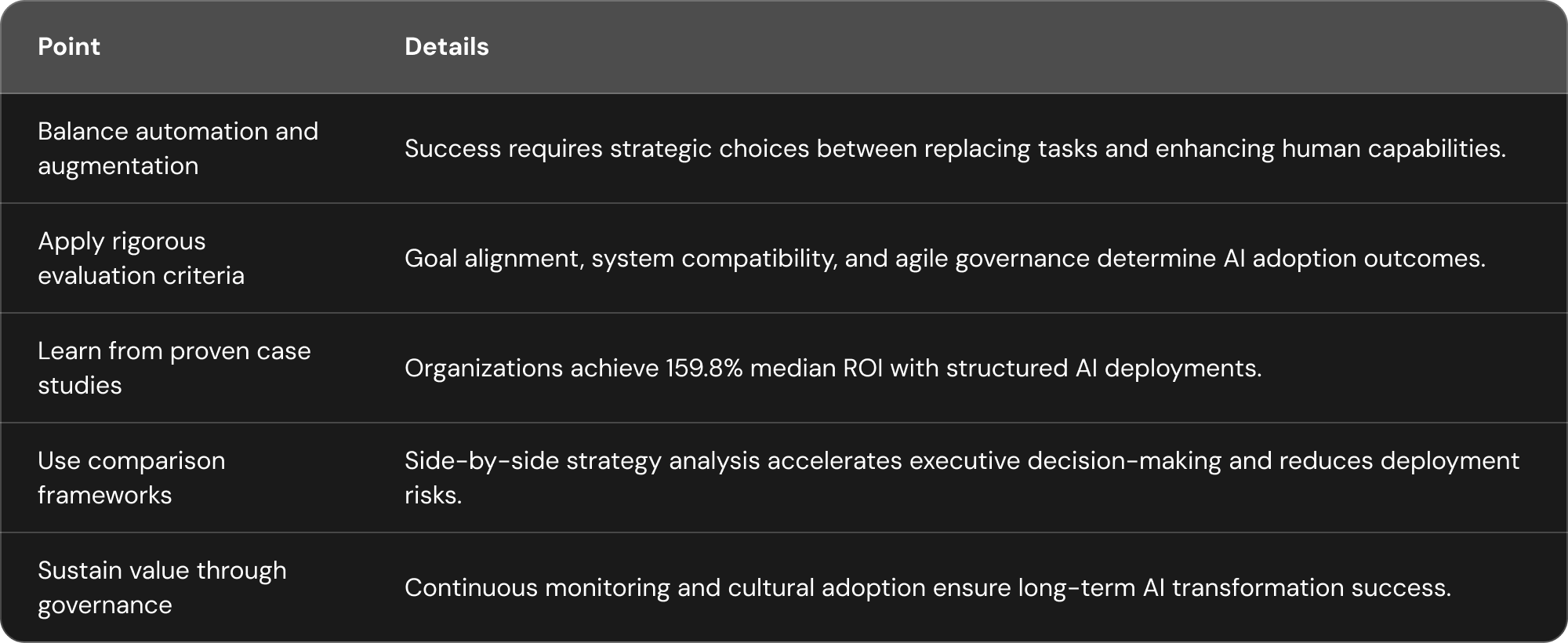
Augmentation models position AI as assistive technology that amplifies human capabilities rather than replacing them. These approaches typically generate higher adoption rates because they empower rather than threaten workers. AI deployments achieve 159.8% median ROI and 10-hour weekly productivity gains when properly implemented. Augmentation shines in scenarios requiring judgment, creativity, or complex problem-solving where AI provides insights while humans make final decisions.
Hybrid human-in-the-loop approaches combine automation’s efficiency with augmentation’s flexibility and risk mitigation. These models deploy AI for initial processing or recommendation generation, then route edge cases or high-stakes decisions to human experts. This balance maximizes efficiency while maintaining quality control and building organizational confidence in AI systems.
Consider Microsoft 365 Copilot as a practical augmentation example. Studies show 38-40% regular usage producing 12% faster document completion among users who integrate the tool into daily workflows. Users report significant time savings on email composition and meeting summarization, freeing capacity for strategic work. This demonstrates augmentation’s value in knowledge work environments where AI accelerates routine tasks without replacing human expertise.
When evaluating options, assess operational fit carefully. Customer-facing roles may require human-in-the-loop models to maintain service quality, while back-office processes might benefit from aggressive automation. Your AI efficiency strategy should align deployment models with specific workflow characteristics and business priorities.
Step 3: Compare AI strategies side by side
Systematic comparison of AI strategy frameworks reveals critical tradeoffs between innovation speed, operational risk, and value creation potential. This analysis enables data-driven decisions aligned with your organizational capabilities and ambitions.
.png)
The Forrester TEI study shows 116% ROI and $36.8 million in three-year benefits for Microsoft 365 Copilot deployments, validating augmentation strategies’ financial impact. Organizations pursuing augmentation-led approaches report higher user satisfaction and faster adoption curves compared to displacement-driven models that trigger workforce anxiety.
Governance structure profoundly influences strategy success. Governance should enable speed, avoid bureaucracy, and favor augmentation in early deployment phases. Heavy governance processes designed for traditional IT projects often suffocate AI initiatives that require rapid experimentation and iteration. Successful organizations implement lightweight approval frameworks that maintain oversight without creating bottlenecks.
Augmentation strategies consistently yield higher value because they leverage existing human expertise rather than attempting to replicate it entirely. This approach also generates less organizational resistance, accelerating time-to-value. Workers view augmentation tools as career enhancers rather than job threats, leading to enthusiastic adoption and creative use case discovery.
Risk profiles vary significantly across strategies. Status Quo carries minimal implementation risk but guarantees competitive disadvantage as rivals advance. Displacement-Driven strategies promise maximum efficiency gains but risk substantial disruption, employee turnover, and quality issues if executed poorly. Human-in-Loop models offer balanced risk-reward profiles suitable for most organizations.
Pro Tip: Start with augmentation-led strategies in pilot departments to build organizational confidence and capture quick wins, then expand to human-in-loop or displacement models as strategic AI innovation maturity increases and legacy system constraints are resolved.
Step 4: Decide and execute your AI innovation roadmap
Transforming strategy analysis into operational reality requires structured execution that engages stakeholders, phases deployments intelligently, and establishes sustainable governance. Follow these proven steps to bring your AI roadmap to life.
- Engage diverse stakeholders early in planning to secure buy-in and surface realistic constraints. Include technical teams, business unit leaders, frontline workers, and governance representatives. This cross-functional input prevents blind spots that derail implementations.
- Define phased deployments aligned with your chosen balance of augmentation and automation. Start with high-value, lower-complexity use cases that demonstrate quick wins and build momentum. Sequence subsequent phases to progressively tackle more challenging applications as capabilities mature.
- Implement governance frameworks prioritizing speed and flexibility over rigid controls. Establish clear decision rights, streamlined approval processes, and rapid feedback loops. Your governance model should facilitate experimentation while managing risks appropriately for each deployment phase.
- Monitor ROI and productivity metrics continuously to enable course corrections. Track both quantitative measures like time savings and qualitative indicators such as user satisfaction and adoption rates. Organizational AI success rates reach 73% with structured deployment and governance, compared to much lower rates for ad hoc approaches.
- Plan for culture and skills development to sustain long-term AI value. Technical deployment alone fails without corresponding workforce transformation. Invest in training programs, change management, and incentive structures that encourage AI adoption and innovative use case discovery.
- Adopt human-in-the-loop models where augmentation is prioritized, ensuring AI recommendations receive expert review before implementation. This approach builds trust, maintains quality standards, and creates learning opportunities that improve both human and AI performance over time.
Successful execution requires balancing ambition with pragmatism. Organizations that acknowledge legacy system constraints and governance realities while maintaining clear transformation goals achieve sustainable AI transformation impact that compounds over multiple years.
Explore tailored AI transformation solutions with iForAI
Building an effective AI innovation roadmap requires more than frameworks and case studies. It demands expert guidance tailored to your organization’s unique challenges, capabilities, and ambitions. iForAI specializes in transforming AI strategy into measurable business impact through customized transformation programs.
Discover how a global tech company became an AI adoption leader through strategic implementation aligned with operational realities. Learn how an AI hackathon drove a 36% jump in AI familiarity across an entire organization, accelerating cultural adoption and use case discovery. Explore proven AI transformation frameworks that balance automation and augmentation to maximize ROI while building sustainable capabilities.
What is an AI innovation roadmap and why is it important?
What is an AI innovation roadmap and why is it important?
An AI innovation roadmap is a strategic plan that guides AI adoption and transformation across organizational levels, aligning initiatives with business goals and operational realities. It provides a structured framework for evaluating options, sequencing deployments, and measuring progress toward defined outcomes. Without a clear roadmap, organizations risk scattered pilot projects that fail to deliver enterprise-wide value or sustainable competitive advantage.
How do I balance automation and augmentation in AI strategy?
Prioritize AI that complements human skills through augmentation to increase adoption and value creation. Pure automation suits repetitive tasks but often faces resistance and implementation risks that limit ROI. Augmentation strategies deliver higher value than automation alone because they leverage existing expertise while building workforce confidence. Hybrid human-in-the-loop models offer the best balance for most organizations.
What metrics should I track to measure AI innovation success?
Track ROI percentage, productivity improvements measured in hours saved per week, and direct impact on revenue or cost metrics aligned with strategic goals. Monitor user adoption rates and frequency of AI tool usage to assess cultural integration and identify training needs. Successful AI deployments report median 159.8% ROI and 10-hour weekly productivity gains, providing benchmarks for your own AI efficiency metrics.
How can legacy systems affect AI adoption and how to overcome it?
Legacy system constraints create AI deployment blockers through technical incompatibilities, data quality issues, and integration complexity that derail implementations. Governance frameworks must prioritize fast iterative deployment over slow bureaucratic approval processes that compound legacy challenges. Overcome these barriers through rigorous technical audits during planning, phased integration approaches that minimize disruption, and governance models designed for speed rather than control.
Recommended