

.svg)


6
min read

March 20, 2026
Organizations invest millions in AI technology but often struggle to realize meaningful returns because staff lack the training to use these tools effectively. The gap between AI enthusiasm and actual workforce capability creates friction that stalls digital transformation initiatives. This guide walks you through a proven framework for preparing, executing, and verifying AI training programs that convert technology investments into measurable business outcomes. You’ll learn how to overcome human barriers, align training with strategic goals, and build the AI-ready workforce your organization needs to compete in 2026.
Table of Contents
- Understanding The Problem: Why AI Staff Training Is Critical
- Preparing Your Organization: Tools, Prerequisites, And Strategy Alignment
- Executing Effective AI Training Programs For Your Staff
- Verifying Success And Continuously Improving AI Training Outcomes
- Explore Proven AI Training Solutions With Iforai
- Frequently Asked Questions
Key takeaways
Understanding the problem: why AI staff training is critical
Most AI initiatives fail not because of technology limitations but because organizations neglect the human side of implementation. Change resistance, skills gaps, unclear roles, and misaligned incentives create barriers that prevent teams from adopting even the most sophisticated AI tools. When employees don’t understand how AI fits into their daily workflows, expensive platforms sit unused while productivity gains remain theoretical.
The disconnect between executive vision and workforce capability manifests in several ways. Leadership announces ambitious AI strategies while frontline staff struggle with basic prompting techniques. Technical teams build powerful models that business users can’t operationalize. Marketing departments invest in AI content tools but lack the training to produce quality outputs. These gaps compound over time, turning initial AI enthusiasm into aversion as frustrated employees revert to familiar manual processes.
Consider these common scenarios that reveal training deficiencies:
- Sales teams ignore CRM AI features because no one explained how predictive scoring improves conversion rates
- Customer service representatives bypass chatbot escalation protocols due to unclear handoff procedures
- Data analysts manually compile reports despite having access to automated AI dashboards
- Project managers avoid AI scheduling tools because they fear losing control over resource allocation
The paradox intensifies when you examine organizational behavior. Only 14% of organizations have formal AI strategies despite two-thirds claiming to implement AI beyond exploratory phases. This gap signals a fundamental misalignment between technology adoption and workforce readiness. Companies rush to deploy AI solutions without building the training infrastructure needed to support them.
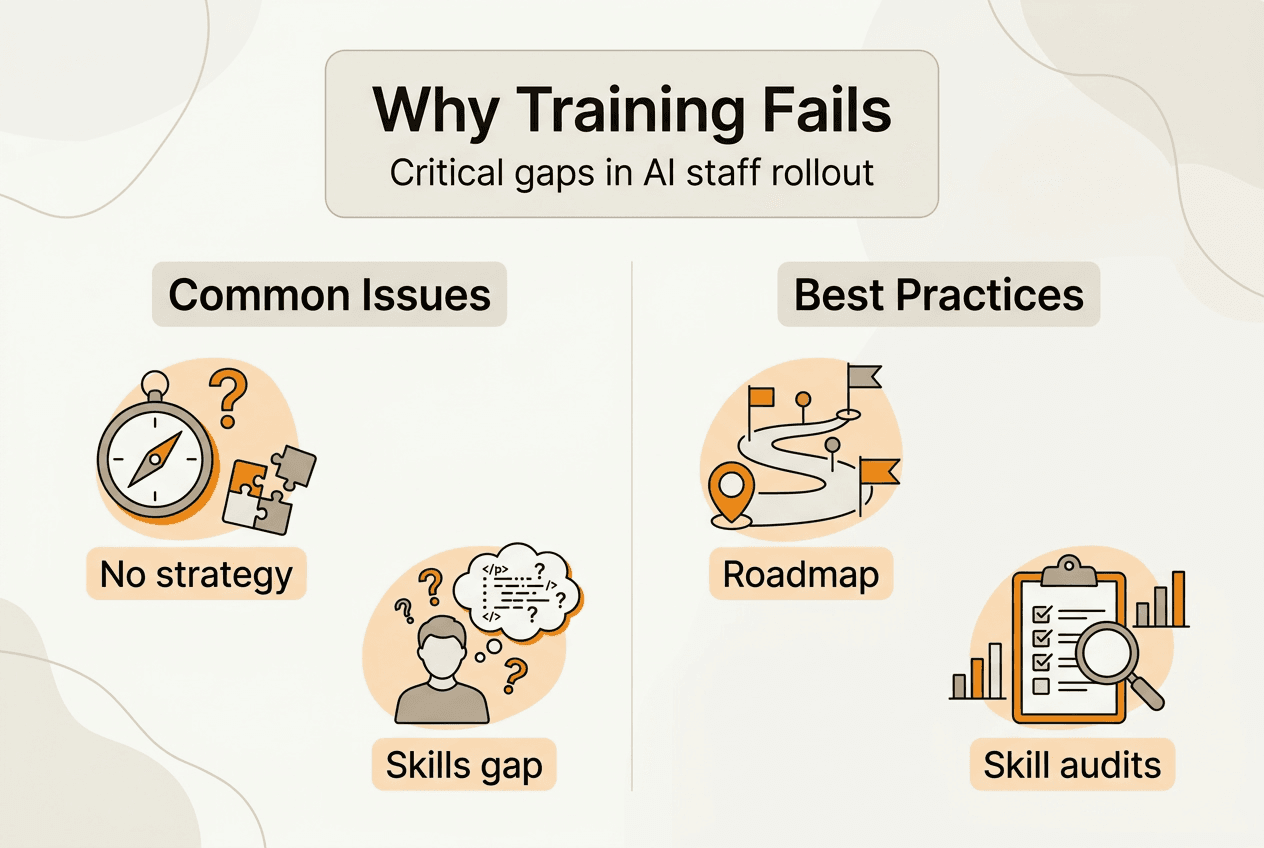
Pro Tip: Survey your teams before launching AI tools to identify specific skill gaps and resistance points, then design training modules that directly address these concerns rather than using generic AI education content.
The cost of inadequate training extends beyond wasted software licenses. Projects stall as teams wait for technical support to handle routine tasks. Innovation slows when employees lack confidence to experiment with AI capabilities. Competitive advantages erode as rivals with better-trained workforces execute faster. Most critically, talented employees leave organizations that fail to provide the AI skills they need to remain marketable in 2026’s job market.
Preparing your organization: tools, prerequisites, and strategy alignment
Successful AI training starts long before the first workshop session. You need strategic alignment between your AI roadmap and workforce development plans to ensure training efforts support actual business objectives. Begin by documenting your organization’s AI maturity level and identifying which capabilities require immediate attention versus long-term development.

Assess current staff capabilities through skills audits that reveal specific knowledge gaps. Don’t rely on self-reported proficiency levels, which typically overestimate actual competence. Instead, use practical assessments where employees demonstrate their ability to complete real tasks using AI tools. A marketing manager might claim AI expertise but struggle to write effective prompts for content generation. A data analyst might understand machine learning concepts but lack hands-on experience with your specific platforms.
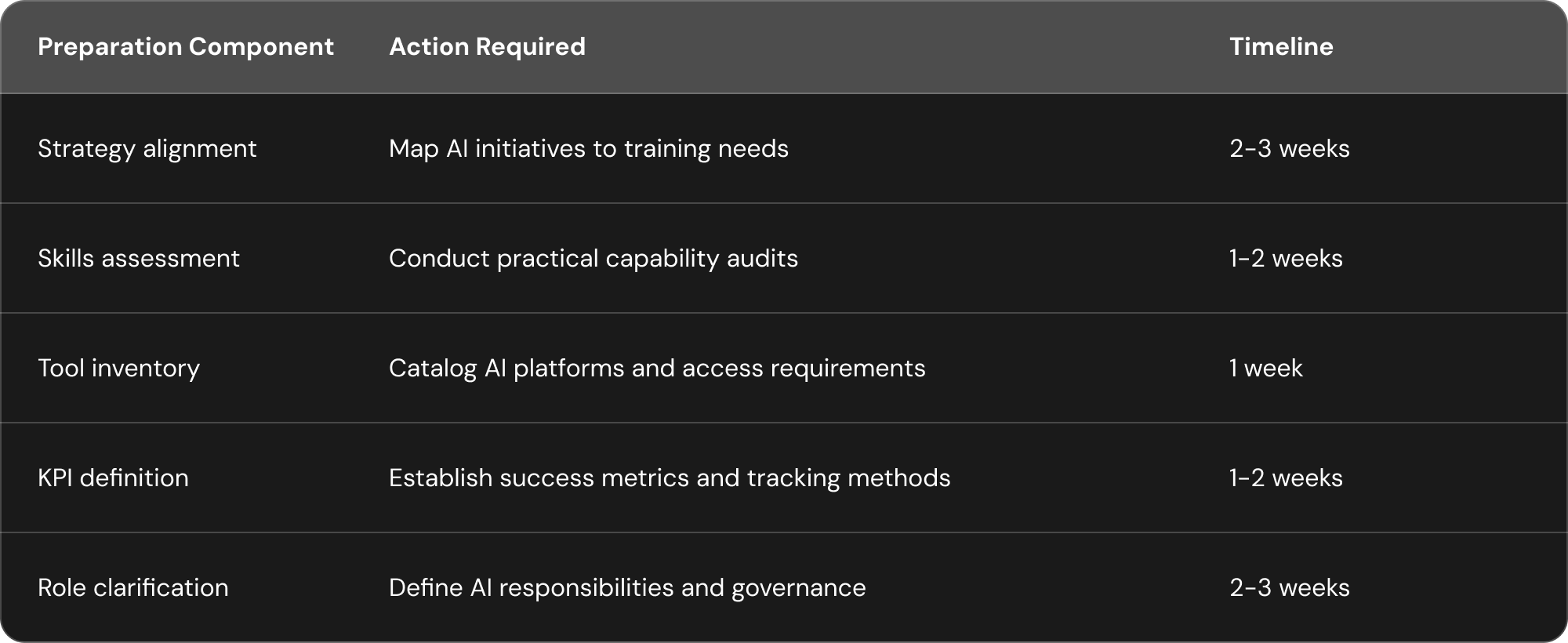
Gather the specific AI tools and platforms your teams will use during training. Generic AI education fails because it doesn’t connect to daily workflows. If your sales team uses Salesforce Einstein, training should focus on that platform rather than abstract AI concepts. If your development team works with GitHub Copilot, exercises should involve actual coding scenarios they encounter. This contextual approach accelerates adoption because employees immediately see relevance to their work.
Define measurable KPIs that connect training to business outcomes. Time saved per employee provides concrete evidence of efficiency gains. Project completion rates show whether teams can successfully execute AI initiatives. Adoption metrics reveal which tools gain traction versus which collect digital dust. Revenue impact demonstrates whether AI capabilities translate to customer value. These metrics create accountability and help you refine training programs based on actual results.
Establish clear roles and responsibilities for both training delivery and ongoing AI governance. Identify internal champions who can support peers after formal training ends. Designate AI leads within each department who maintain expertise and troubleshoot issues. Create escalation paths for technical problems that exceed team capabilities. This infrastructure ensures training benefits persist beyond initial workshops.
Pro Tip: Create an AI tools matrix that maps each platform to specific job roles and use cases, then prioritize training based on which combinations deliver the highest business value rather than trying to train everyone on everything.
The preparation phase also requires addressing organizational culture and incentive structures. If performance reviews don’t recognize AI adoption, employees lack motivation to change behaviors. If managers resist workflow changes, training efforts face systematic opposition. Align compensation, recognition, and advancement criteria with AI proficiency to create genuine incentives for skill development. This cultural foundation determines whether training produces lasting transformation or temporary enthusiasm.
Executing effective AI training programs for your staff
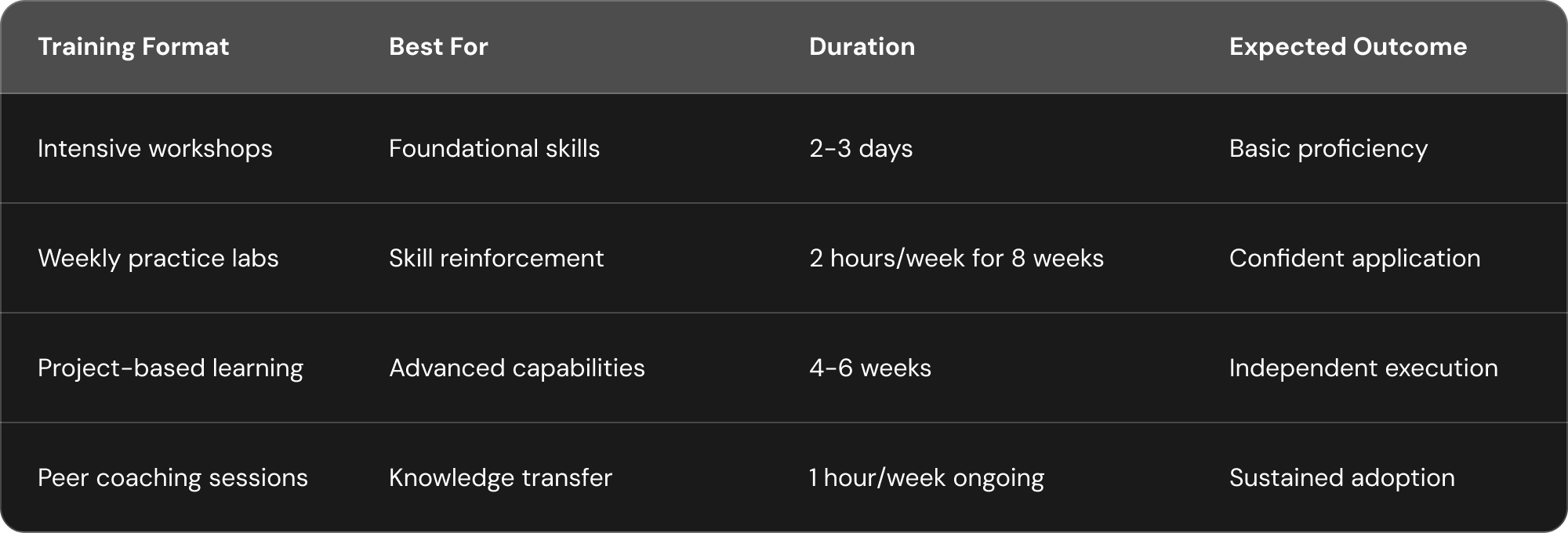
Effective execution requires moving beyond passive learning to hands-on practice with real business scenarios. Structure your training program around Modular Efficiency Pods that focus on specific tasks rather than comprehensive AI theory. A customer service pod might concentrate solely on using AI to resolve common inquiries faster. A content creation pod could focus exclusively on generating marketing copy that maintains brand voice. This modular approach lets employees master practical skills quickly instead of drowning in abstract concepts.
Implement these execution steps in sequence:
- Launch with quick wins that demonstrate immediate value and build confidence
- Progress to more complex applications once basic proficiency is established
- Integrate AI tools into existing workflows rather than creating parallel processes
- Schedule regular practice sessions where teams apply skills to actual work projects
- Provide on-demand support resources for troubleshooting and advanced techniques
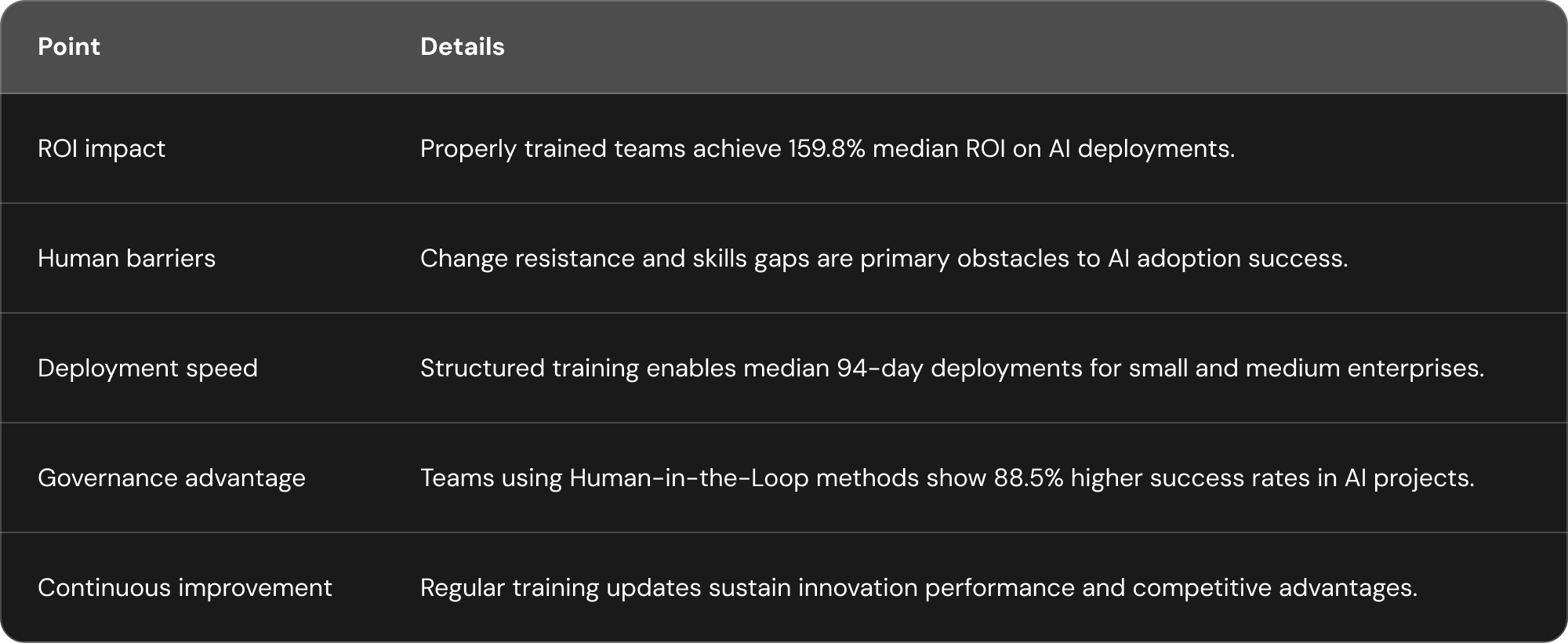
Incorporate Human-in-the-Loop governance from the start to ensure quality and maintain engagement. 88.5% of top-performing AI projects utilize HITL approaches where humans review AI outputs and provide feedback that improves system performance. This governance model serves dual purposes: it protects against AI errors while giving employees meaningful control over technology they might otherwise resist. When teams see their input shaping AI behavior, they transition from passive users to active collaborators.
Set realistic timeline expectations based on organizational size and complexity. Analysis of 200 B2B AI deployments revealed a median deployment time of 94 days for small and medium enterprises, with a 159.8% median ROI and 73% success rate. These benchmarks help you communicate reasonable timeframes to stakeholders while avoiding the trap of expecting overnight transformation. Rushing training produces superficial adoption that crumbles under pressure, while overly cautious approaches let competitors capture market advantages.
Source: Baromètre IA & ROI des PME françaises 2022–2025, Denis Atlan (ENDKOO) — analysis of 200 B2B AI deployments.
Track progress through practical demonstrations rather than written tests. Have sales representatives conduct live AI-assisted customer calls. Ask content creators to produce publication-ready materials using AI tools. Require analysts to generate insights from real datasets. These performance-based assessments reveal actual capability levels and identify individuals who need additional support before they struggle with production work.
Pro Tip: Record successful AI workflows created by early adopters and turn them into reusable templates that accelerate training for subsequent cohorts while establishing best practices across your organization.
Create feedback loops where participants share what works and what doesn’t. Early training iterations always contain gaps between instructional design and practical application. Teams discover workarounds, identify missing features, and uncover use cases trainers hadn’t considered. Capture this intelligence and rapidly incorporate it into training materials. Organizations that treat training as an evolving program rather than a one-time event achieve significantly higher adoption rates and sustained innovation performance.
Verifying success and continuously improving AI training outcomes
Verification starts with measuring the KPIs you defined during preparation. Calculate employee time saved by comparing task completion speeds before and after AI adoption. A content team that previously spent 8 hours per article but now completes quality drafts in 3 hours demonstrates clear efficiency gains. A sales team that closes deals 30% faster using AI research tools shows measurable productivity improvements. These metrics provide concrete evidence of training ROI that justifies continued investment.
Monitor deployment success rates and adoption patterns across different teams and use cases. Some AI applications gain immediate traction while others face persistent resistance. High adoption rates signal effective training and genuine utility. Low adoption despite extensive training indicates either tool-task misalignment or unresolved human barriers. Investigate the root causes rather than assuming more training will solve the problem. Sometimes the issue isn’t skill deficiency but workflow incompatibility.
Watch for warning signs that training momentum is declining. AI-specific workforce upskilling investments dropped from 42% to 36% between 2025 and 2026 even as AI adoption accelerated. This paradox suggests organizations mistakenly believe initial training suffices for long-term success. In reality, rapid AI evolution requires continuous learning to maintain competitiveness. Budget cuts to training programs often precede adoption plateaus and competitive disadvantages.
Key verification metrics to track continuously:
- Percentage of staff actively using AI tools in daily workflows
- Average time saved per employee across different AI applications
- Project completion rates for AI-enabled versus traditional approaches
- Quality scores for AI-assisted outputs compared to manual work
- Employee confidence levels and satisfaction with AI capabilities
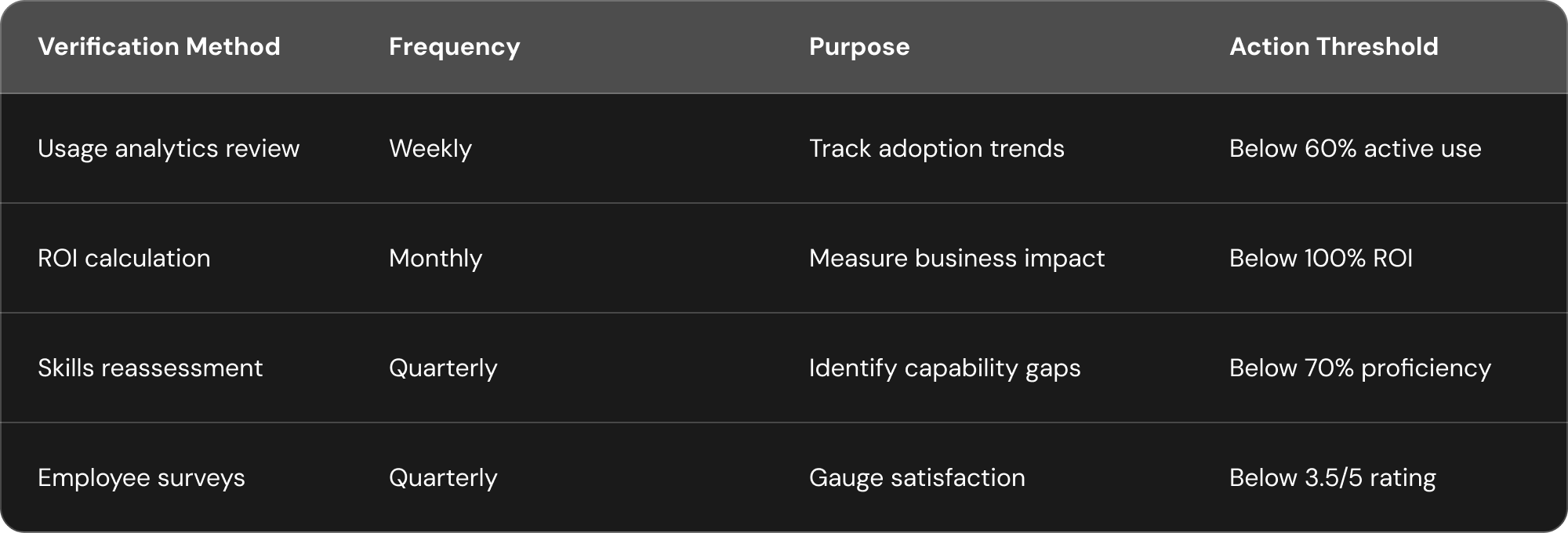
Use feedback loops to refine training content and delivery methods. Participants provide valuable insights about which modules delivered immediate value versus which felt theoretical or disconnected from real work. Some teams prefer intensive workshops while others learn better through distributed practice sessions. Certain roles need deep technical training while others require only high-level operational knowledge. Customize your approach based on actual learner needs rather than instructional design assumptions.
Pro Tip: Establish an internal AI community of practice where employees share discoveries, troubleshoot challenges, and celebrate wins to create self-sustaining momentum that reduces dependence on formal training programs.
Encourage a continuous learning culture that treats AI skill development as an ongoing journey rather than a destination. Technology evolves rapidly, with new capabilities and best practices emerging constantly. Organizations that build learning into regular workflows rather than treating it as periodic events maintain competitive advantages and innovation performance. Schedule monthly learning sessions where teams explore new AI features. Create channels for sharing tips and discoveries. Recognize employees who develop innovative AI applications. These cultural elements sustain the workforce transformation that training programs initiate.
Explore proven AI training solutions with iForAI
Transforming your workforce into AI-capable teams requires more than generic training programs. iForAI specializes in customized AI transformation initiatives that align with your specific business objectives and organizational culture. Our proven methodologies have helped enterprises achieve measurable adoption success, including a 36% jump in AI familiarity through targeted hackathon programs.
Whether you need strategic guidance for AI integration or hands-on training workshops, our team of AI advisors brings practical experience from successful deployments across industries. Explore our AI adoption case studies to see how organizations like yours have accelerated digital transformation. Download our AI Hackathon Playbook to replicate proven engagement strategies that turn AI enthusiasm into organizational capability. Partner with experts who understand that effective AI training isn’t about technology alone but about empowering people to drive innovation.
Frequently asked questions
How long does effective AI training usually take?
Effective AI training deployments for small and medium enterprises typically require a median of 94 days from initiation to productive use. This timeline includes initial skills assessment, structured training delivery, hands-on practice, and verification of competency. Larger organizations with more complex workflows may need 4-6 months for comprehensive rollout. Modular training approaches that focus on specific use cases accelerate learning compared to broad theoretical programs. Regular updates and continuous learning sessions extend beyond initial deployment to maintain proficiency as AI capabilities evolve.
What are the biggest challenges when training staff in AI?
Human factors present the primary barriers to successful AI training, including resistance to change, skills gaps, unclear role definitions, and misaligned incentives. Employees often fear AI will replace their jobs or expose their limitations, creating psychological resistance that undermines learning efforts. Technical complexity overwhelms users when training lacks practical context tied to daily workflows. Organizations that address these human challenges through clear communication, relevant examples, and supportive culture achieve significantly higher adoption rates than those focusing solely on technical instruction.
How can organizations measure the success of AI staff training?
Measure training success through concrete business metrics like employee time saved, project completion rates, and ROI improvements rather than relying on satisfaction surveys alone. Track actual usage rates of AI tools to distinguish between superficial familiarity and genuine adoption. Calculate efficiency gains by comparing task completion times before and after training. Monitor quality scores for AI-assisted outputs to ensure speed improvements don’t compromise work standards. Gather participant feedback about confidence levels and perceived value, then correlate these subjective measures with objective performance data to identify gaps between training effectiveness and business impact.
Why is aligning AI strategy with workforce development important?
Strategic alignment ensures training investments support actual business objectives rather than creating capabilities your organization won’t use. When AI strategy and workforce development operate independently, you risk training staff on tools that don’t match your technology roadmap or building technical infrastructure your teams can’t operationalize. Alignment prevents wasted resources on generic AI education that doesn’t translate to competitive advantages. Organizations with integrated strategies deploy AI faster, achieve higher ROI, and sustain innovation momentum because their workforce capabilities evolve in tandem with technology adoption rather than lagging behind or racing ahead without purpose.
Recommended