


.svg)

Most executives believe adopting AI tools equals transformation, yet 70% of AI projects fail to deliver expected business value. True AI transformation isn’t about deploying chatbots or automating tasks. It requires reimagining your entire business model, workflows, and decision-making processes around intelligent systems. This guide clarifies what AI transformation actually entails, why it matters for competitive survival in 2026, the obstacles blocking success, and proven strategies to navigate your journey from experimentation to enterprise-wide AI integration that drives measurable growth.
Table of Contents
- Understanding AI Transformation: More Than Just Technology
- Key Obstacles And Pitfalls In Achieving AI Transformation
- Strategies And Frameworks For Successful AI Transformation
- Measuring Impact And Scaling Successful AI Transformation
- Discover Tailored AI Transformation Solutions With Iforai
- Frequently Asked Questions About AI Transformation
Key takeaways
Understanding AI transformation: more than just technology
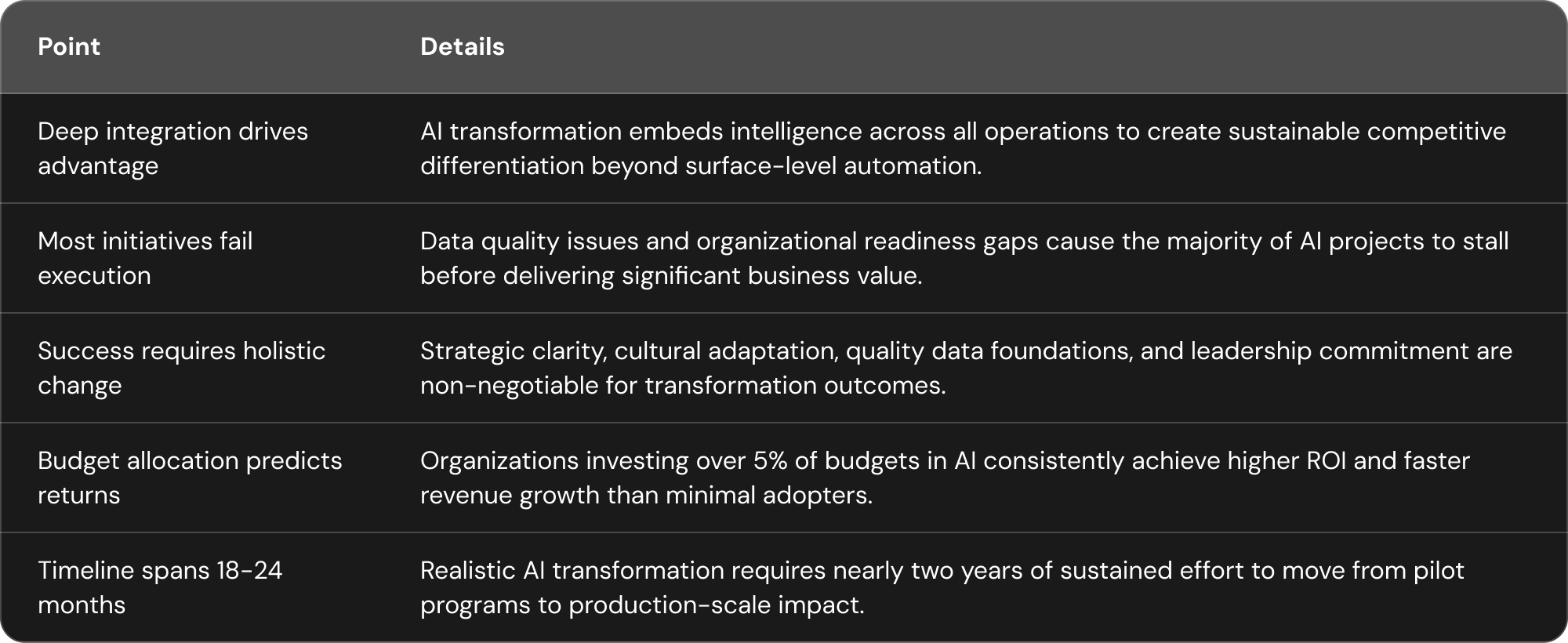
AI transformation means integrating artificial intelligence deeply across your operations, culture, and business model to drive innovation and competitive advantage. This goes far beyond buying software or running isolated pilots. Organizations that treat AI as transformative achieve 3.7x-10.3x ROI compared to those adding AI superficially to existing processes. The difference lies in reimagining how work gets done, not just automating current workflows.
Consider the contrast. Superficial AI adoption involves deploying tools without changing underlying processes. You might add a chatbot to customer service while keeping the same slow escalation procedures. Transformative AI adoption rebuilds customer service around intelligent routing, predictive issue resolution, and continuous learning from interactions. The latter requires rethinking roles, workflows, and success metrics.
The business case is compelling. AI leaders have 1.7x higher revenue growth, showcasing competitive benefits of full integration. Yet nearly 89% of organizations use AI regularly, but few embed it deeply enough for real financial impact. This gap reveals the challenge: adoption is easy, transformation is hard.
True AI transformation encompasses several critical elements:
- Redesigning your operating model around data-driven decision making at every level
- Building AI literacy and capabilities across all functions, not just technical teams
- Establishing governance frameworks that balance innovation with responsible AI practices
- Creating feedback loops where AI systems continuously improve from operational data
- Aligning incentives and culture to reward experimentation and intelligent automation
These elements work together. You can’t achieve driving faster smarter innovation with AI by focusing solely on technology infrastructure. The strategic advantages of AI integration emerge when technical capability meets organizational readiness.
Pro Tip: Avoid the trap of perpetual experimentation. Many organizations spent 2023-2025 running endless pilots without committing to transformation. Set clear timelines for moving successful pilots to production, or kill them. Experimentation without deployment wastes resources and creates transformation fatigue.
Research on AI digital transformation shows that leaders who commit to full transformation outperform those treating AI as just another technology investment. The question isn’t whether to transform, but how quickly you can execute.
Key obstacles and pitfalls in achieving AI transformation
Data quality and governance represent the most significant barriers to AI success. 77% of organizations rate their data quality as average, poor, or very poor, directly hindering AI effectiveness. Without clean, accessible, well-governed data, even the most sophisticated AI models produce unreliable outputs. This isn’t a technical problem you can solve by hiring more data scientists. It requires enterprise-wide commitment to data hygiene, lineage tracking, and quality standards.

The failure statistics are sobering. 60% of AI projects are abandoned when AI-ready data foundations are missing. Even more concerning, nearly two-thirds of organizations remain stuck in AI pilot mode, with only 4 out of 33 pilots reaching production on average. These numbers reveal a pattern: companies launch initiatives without addressing fundamental readiness gaps.
Common pitfalls include:
- Unclear business cases that focus on technology novelty rather than solving specific high-value problems
- Insufficient AI expertise across business units, creating dependency bottlenecks on small technical teams
- Fragmented technology ecosystems where AI tools can’t integrate with existing systems
- Lack of executive sponsorship beyond initial approval, leading to resource constraints when challenges emerge
- Unrealistic timelines that expect transformation in months rather than the typical 18-24 month reality
Organizational readiness blocks often prove more difficult than technical challenges:
- Cultural resistance from employees who fear job displacement or don’t understand AI benefits
- Siloed departments that refuse to share data or collaborate on cross-functional AI initiatives
- Risk-averse leadership that demands guaranteed ROI before investing in necessary infrastructure
- Inadequate change management that fails to prepare teams for new AI-augmented workflows
- Missing governance frameworks that create compliance risks and slow deployment
Understanding your AI maturity and readiness helps identify which obstacles pose the greatest threat to your transformation. Organizations that assess readiness honestly and address gaps systematically avoid common failure patterns. The connection between AI maturity as success factor and business outcomes is direct and measurable.
Pro Tip: Invest in data foundation work before launching AI pilots. Spend six months cleaning critical data sources, establishing governance, and building pipelines. This upfront investment reduces project abandonment rates and accelerates every subsequent AI initiative. Organizations that skip this step waste resources on pilots that can’t scale.
The lessons learned from AI transformations across industries show that success requires addressing organizational and cultural barriers alongside technical implementation. Technology is rarely the limiting factor in 2026.
Strategies and frameworks for successful AI transformation
Assessing your organizational AI maturity provides the foundation for effective transformation. Evaluating AI readiness across seven dimensions enables customized roadmaps and focused maturity advancement. These dimensions include strategy alignment, data infrastructure, governance frameworks, technical capabilities, cultural readiness, operational integration, and measurement systems. Understanding your current state in each area prevents wasting resources on initiatives your organization isn’t ready to support.

The maturity model helps executives prioritize investments:
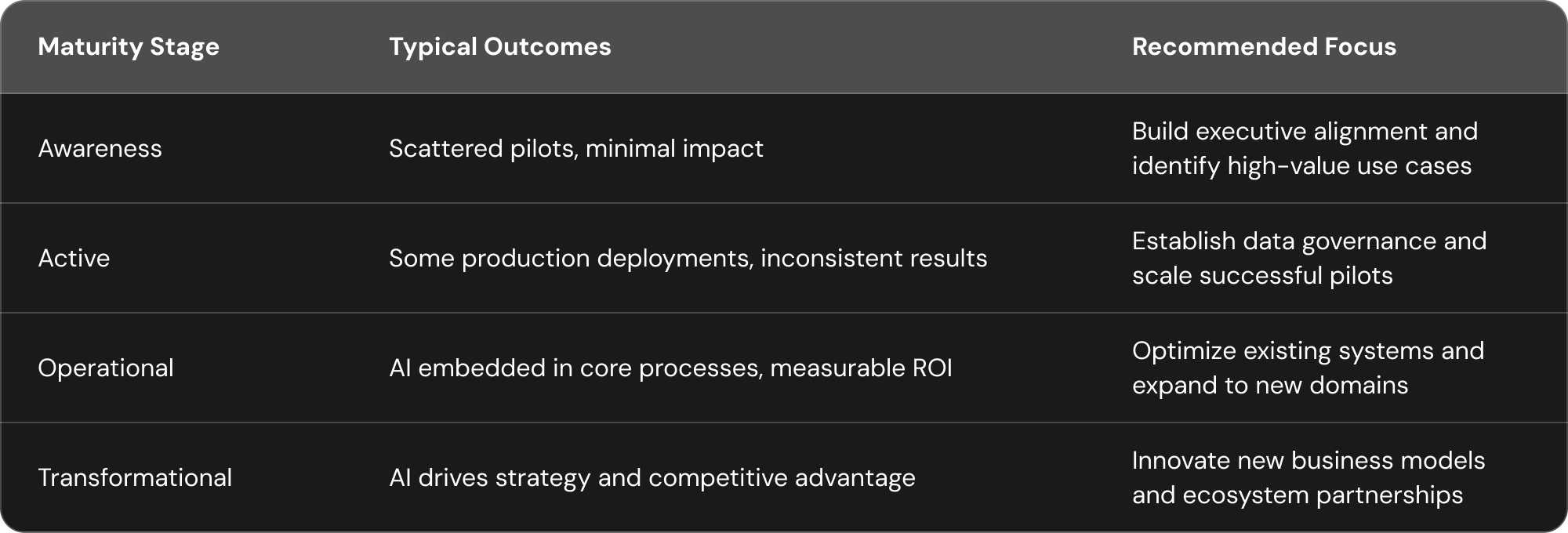
Strategic clarity, infrastructure, quality data, proper deployment and governance are key success factors that separate leaders from laggards. Strategic clarity means defining specific business outcomes AI will enable, not vague goals like “become AI-first.” Infrastructure includes cloud platforms, MLOps tools, and integration capabilities. Quality data requires ongoing investment in collection, cleaning, and governance. Proper deployment means moving beyond pilots to production systems that handle real workloads. Governance balances innovation speed with risk management and compliance.
Actionable steps for building AI capabilities:
- Start with business problems that have clear ROI potential and executive sponsorship
- Build cross-functional teams combining domain experts, data scientists, and engineers
- Establish centers of excellence that spread best practices and reusable components
- Invest in upskilling programs that create AI literacy across all organizational levels
- Create feedback mechanisms where business users continuously improve AI systems
- Partner with experienced advisors who have guided similar transformations
Enterprises typically follow an 18-24 month AI implementation timeline to realize benefits. This timeline includes assessment, foundation building, pilot development, production deployment, and scaling phases. Rushing this process leads to the high failure rates discussed earlier. Patient, systematic execution produces sustainable results.
Examples of advanced AI powering enterprise innovation demonstrate how strategic frameworks for AI innovation translate into competitive advantage. The relationship between AI transformation and enterprise growth becomes clear when organizations execute systematically rather than opportunistically.
Pro Tip: Develop a customized AI roadmap that maps initiatives to maturity progression across all seven dimensions. Use this roadmap in quarterly reviews to monitor progress, reallocate resources, and maintain cross-functional alignment. The roadmap prevents transformation from devolving into disconnected projects that don’t build on each other.
The Gartner AI maturity model provides detailed assessment tools and benchmarks. Adapting these frameworks to your industry context and organizational culture increases adoption and reduces resistance.
Measuring impact and scaling successful AI transformation
Defining clear metrics separates successful AI transformation from expensive experimentation. Key metrics for evaluating AI impact include:
- Operational efficiency gains measured through cycle time reduction, error rate improvement, and resource optimization
- Customer satisfaction improvements tracked via NPS scores, retention rates, and support resolution times
- Innovation cycle acceleration shown by faster product development, market response, and competitive positioning
- Revenue growth attributed to AI-enabled capabilities, new offerings, and market expansion
- Cost reduction from automation, predictive maintenance, and optimized resource allocation
These metrics must connect directly to business outcomes, not technical performance. Model accuracy matters less than whether the model drives better decisions. Real case studies show 30-60% improvements in operational metrics when AI is well integrated. These aren’t marginal gains. They represent fundamental performance step changes.
Understanding ROI timelines sets realistic expectations:
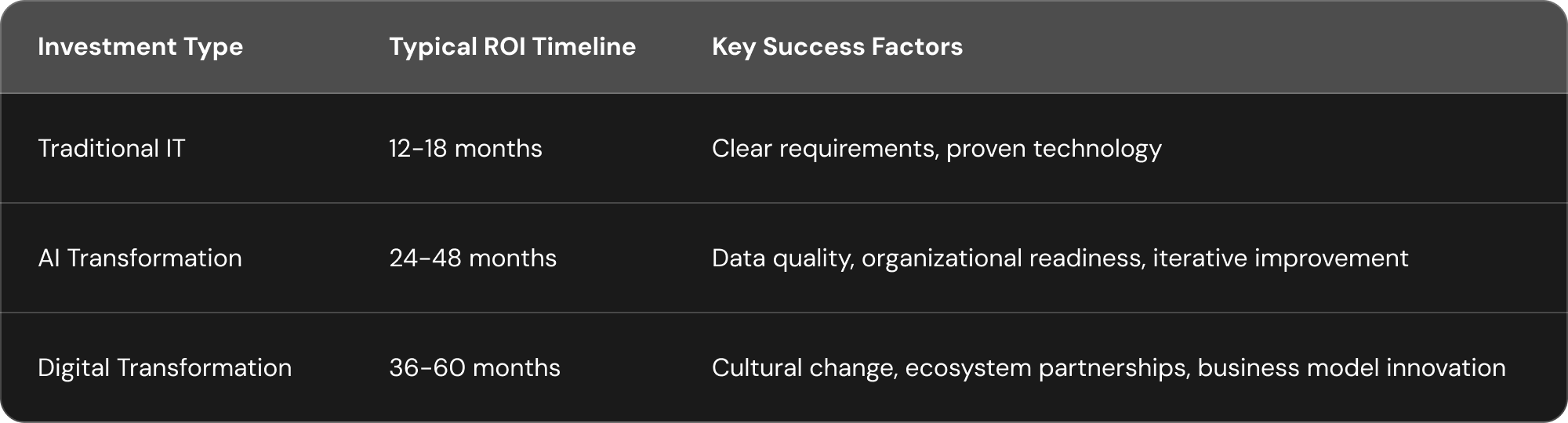
ROI for AI initiatives typically takes 2-4 years, longer than standard tech investments. This extended timeline reflects the need for data foundation work, capability building, and organizational adaptation. Executives who expect 12-month payback often kill promising initiatives prematurely.
The scaling challenge explains why only 5% of companies generate AI value at scale despite many pilots. Scaling requires different capabilities than piloting. Pilots can succeed with manual workarounds and dedicated teams. Production systems need robust data pipelines, automated monitoring, clear ownership, and integration with existing workflows. The gap between pilot and production kills most AI initiatives.
Pro Tip: Establish clear graduation criteria before launching pilots. Define the performance thresholds, data quality standards, and operational readiness requirements that must be met before moving to production. This prevents pilots from lingering indefinitely while creating accountability for both technical teams and business sponsors.
Success stories from AI adoption success case study demonstrate how systematic approaches to measuring AI business impact drive results. Organizations that define metrics early, track them consistently, and adjust based on data achieve the transformational outcomes that justify investment.
Detailed AI transformation ROI data shows that patient, well-executed transformation delivers returns far exceeding initial projections. The key is maintaining commitment through the inevitable challenges and setbacks that occur during multi-year initiatives.
Discover tailored AI transformation solutions with iForAI
Navigating AI transformation requires more than frameworks and best practices. You need experienced partners who have guided enterprises through this journey successfully. iForAI specializes in helping organizations move from AI experimentation to enterprise-wide transformation that delivers measurable growth. Our approach combines strategic assessment, customized roadmap development, hands-on implementation support, and capability building tailored to your industry and maturity level.
Real results demonstrate our impact. Explore how we helped a global tech company become an AI adoption leader through systematic maturity advancement. See how AI-driven order validation boosted margins without expanding headcount. These case studies showcase the practical application of transformation principles discussed throughout this guide.
Our services address every stage of your AI journey, from initial assessment and strategy development through pilot execution and production scaling. We focus on building internal capabilities alongside delivering solutions, ensuring your teams can sustain and expand AI initiatives after engagement. Visit iForAI to explore resources, case studies, and solutions designed specifically for enterprise AI transformation in 2026.
Frequently asked questions about AI transformation
What are key indicators that my organization is ready for AI transformation?
Readiness indicators include executive commitment beyond initial approval, clean accessible data in priority domains, cross-functional collaboration willingness, realistic timeline expectations of 18-24 months, and allocated budget exceeding 5% for AI initiatives. Cultural openness to experimentation and learning from failures also signals readiness.
How long does a typical AI transformation take to deliver results?
Most enterprises require 18-24 months to move from assessment through pilot development to initial production deployments. Full transformation delivering enterprise-wide impact typically spans 2-4 years. Quick wins in specific domains may appear within 6-9 months, but sustainable competitive advantage requires patient systematic execution.
What role does data quality play in AI transformation success?
Data quality determines AI effectiveness more than algorithm sophistication. Poor data quality causes 77% of organizations to struggle with AI initiatives and leads to 60% project abandonment rates. Investing in data governance, cleaning, and pipeline infrastructure before launching AI pilots dramatically improves success probability.
Why do most AI projects fail to scale?
Scaling requires different capabilities than piloting. Most failures stem from inadequate data infrastructure, missing operational integration, unclear ownership, insufficient change management, and unrealistic ROI timelines. Only 5% of companies successfully scale AI because they address these organizational barriers alongside technical implementation.
How can executives best support the AI transformation journey?
Executives should maintain visible sponsorship throughout the 18-24 month timeline, allocate sufficient budget for foundation work and capability building, establish clear governance without micromanaging, celebrate learning from failed experiments, and hold business units accountable for adopting successful AI solutions. Patient commitment through inevitable setbacks separates successful transformations from abandoned initiatives.
Recommended